
Home Blog

Using Runes Alongside Medical Care: A Safety Guide

Man preparing for an appointment beside a closed notebook and small rune pieces

Quick Guide

Keep the roles separate: runes can be an optional reminder or reflection practice; diagnosis, medication, tests, and treatment require qualified healthcare guidance. Never delay urgent help to complete a reading.

On this page

Runes can still be part of your life during your illnesses, recovery, or stressful medical experiences. You can keep a rune journal, carry a symbol that reminds you of courage, or use a short reading to reflect on what kind of support you need. These uses concern personal meaning. Runes aren’t a method for diagnosing illness, picking medication, or treating a medical condition.

Using runes with medical care means keeping this difference clear. Your treatment decisions should be discussed with your healthcare professionals. Your spiritual practice can focus on values, emotions, and everyday actions that help you follow the care you agreed on.

You don’t have to pick between respecting traditions and asking medical questions. A good practice makes room for both. This guide gives original examples of how to do that without exaggerating what runes do.

Decide What You Want from the Practice

Before picking a rune, figure out what kind of help you’re seeking. If you want a moment of quiet before you make an appointment, this is different from wanting to know if a symptom is dangerous or not. The first is a personal ritual, but the second needs medical assessment.

A good intention can be “I want to remember to ask the questions I have clearly,” or “I want to remind myself that I’m allowed to accept help.” Neither of these needs the runes to identify a disease or predict a treatment.

Write down your boundaries so you can understand them. For example, this practice is for reflection, and I’ll use my doctor’s instructions when I make medical decisions. Keeping this note beside your rune can make it easier to pay attention when a reading starts drifting into medical advice.

The National Center for Complementary and Integrative Health advises against replacing or postponing conventional treatment with unproven approaches. Its guide to considering complementary health practices also encourages people to tell their healthcare providers about the approaches they use. The general safety principle applies even when a practice feels gentle or familiar.

Understanding Historical Runes

Runes were once a writing system and survived in inscriptions, including practical messages and materials that were associated with magic and religion. Their historical use is distinct from modern treatment claims. See our guide to rune traditions and evidence for that broader question.

The National Museum of Denmark describes stories of runic healing in the sagas, including an episode involving Egil and a sick young woman. Its account of runic magic provides cultural context. A literary account demonstrates that people told such stories; it does not establish clinical effectiveness. Our article on Egil’s Saga and rune-healing stories explores the historical context.

Modern rune practices can have historical material and recent interpretations. A symbol that was assigned a meaning by one person might be explained differently by another. This is why it’s important to ask where the interpretation comes from, not a reason to fear that picking the wrong stone is going to hurt you.

You can appreciate traditions without saying that every historical belief is a medical instruction. Reading a saga or studying an inscription are different kinds of evidence.

Use Symbols to Support Actions You Already Value

For example, imagine that Mira has a regular follow-up appointment coming up. She picks a rune that she personally connects with communication and puts a drawing of it beside the list of questions she wants to ask. Each time she sees the rune, it reminds her to mention a side effect that she has not really been talking about.

In this situation, the important part is that Mira talks to her healthcare provider about what she has been experiencing. The rune is simply something meaningful that helps remind her to do that. She is not using the rune to decide whether the side effect is serious or whether she should change the amount of medication she takes.

Someone else might connect a certain rune with patience while recovering from an injury or illness. They could put the symbol on a calendar where they keep track of exercises recommended by their care team. The rune can be a personal reminder to stay patient and keep going, while the actual instructions for the exercises still come from the professional who evaluated them.

One way to think about this is to ask if the action would still make sense even if the rune did not have any special power. Asking your healthcare provider a question, making sure you have a ride to an appointment, or following a care plan would still be helpful. On the other hand, deciding not to have a medical test because a rune made you feel like everything would be okay, could put your health at risk.

Keep Medical Questions Out of the Casting

Runes shouldn’t be used to decide whether you have a certain illness, whether a pregnancy is healthy, whether a medication is safe for you, or how long someone is going to live. These are questions that might require things like an examination, medical testing, and the knowledge of a qualified healthcare professional. A rune reading cannot provide that type of information.

If you find yourself wanting to ask a medical question during a rune reading, you can change it into a question about support instead. Instead of asking, “Should I stop taking this medicine?” you could ask, “What can help me talk about my concerns with the person who prescribed it?” Instead of asking, “Will my test results be normal?” you might ask, “What can I do to make the waiting easier?”

Changing the question does not mean that you have to ignore your feelings. It just gives you a safer and more useful way to deal with them. If you are worried about side effects, you can talk with your healthcare provider about the possible benefits, risks, other options, and what symptoms you should watch for. If you are nervous while waiting for test results, you might spend time with someone you trust, make sure you know who to contact with questions, or ask for help with everyday things if you need it.

A reassuring rune reading should also never take the place of medical advice when you develop new symptoms or have been told when to seek help. If you believe you are having a medical emergency, contact emergency services right away. You do not need to do another rune reading or finish a spiritual ritual before getting the help you need.

Rituals Before Appointments

A good routine can take just a few minutes. Put your medication list, appointment details, and questions together before you introduce spiritual elements. Preparing should be useful even when you don’t feel like doing a ritual.

Pick a symbol, or just look at one you already know, and ask yourself, “What do you want to communicate today?” Then write one plain sentence to respond to it.

Add the sentence to the top of your appointment notes. If you want to sit quietly for a few moments with your feet supported and your attention on the room, do this. You don’t have to fast, use incense, or go to a special state of consciousness to do this.

After the appointment is over, record the instructions separately from your rune reflections. This stops symbolic interpretations from becoming mixed with your medical plan. If something seems unclear, talk to your medical team instead of getting another reading.

A Care-First Appointment Routine
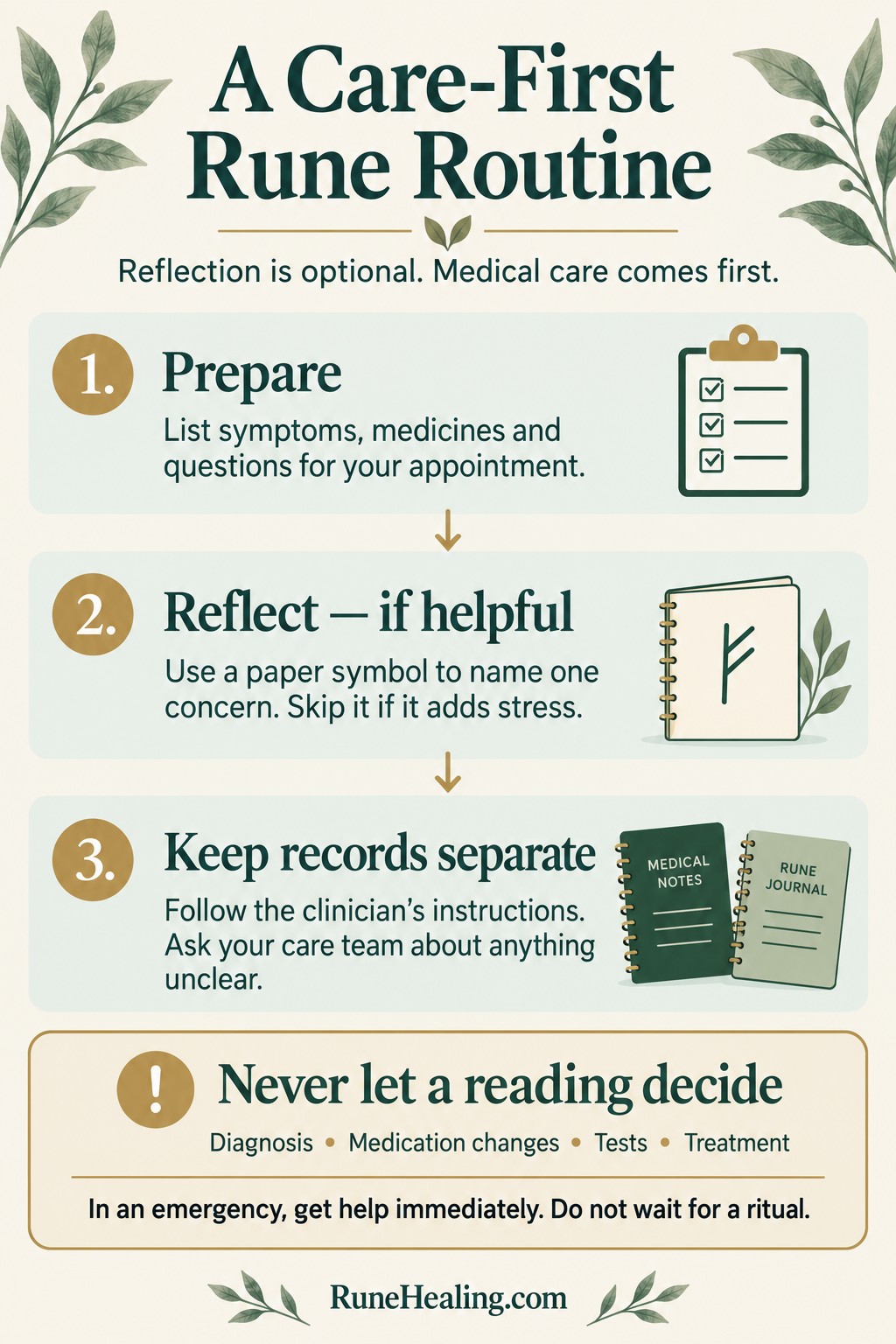
Three-step care-first routine: prepare medical notes, reflect only if helpful, and keep medical instructions separate from rune impressions
A care-first routine: prepare, reflect only if helpful, and keep records separate. Select the infographic to view it at full size. The text checklist below gives the same steps.
1. Prepare the medical essentials

Gather medication details, symptoms, appointment information, and questions.

2. Add optional reflection

Use a paper rune or brief journal prompt to identify one concern you want to raise. Skip it if it adds stress.

3. Keep separate records

Write the clinician’s instructions separately from symbolic impressions. Clarify uncertainties with the care team.

Check Materials and Physical Safety

A rune drawn on paper avoids practical issues associated with ritual materials. Small stones can be choking hazards for small children or pets. Sharp carvings or unknown materials can cause problems.

Never swallow the rune stones, drink water that has unknown stones or metal, or put unverified creams on wounds. A ritual label doesn’t tell you if a substance is safe for the body or not. If a practice includes herbs, supplements, oils, or other things, always check with the pharmacist or doctor before you use them medically.

The NHS explains that complementary therapies and herbal products can be unsuitable for some people and can interact with existing care. Its overview of herbal medicines and complementary therapies is a useful starting point for those additional products. It should not be read as evidence that rune casting treats illness.

In a hospital or clinic, follow the rules about belongings, infection control, fragrances, flames, and devices. Ask if a small paper symbol can stay nearby if it’s comforting to you. The staff can help identify what works in the care environment.

Talking to Your Doctor

You don’t have to give an explanation of your spiritual outlook to your doctor, and a good description makes the conversation easier. You can tell your doctor you use rune cards for journaling and that you’re not changing your treatment because of them.

If your practice includes physical products or procedures, talk about them specifically. A spiritual remedy is not enough information when you need to tell the exact supplement name, ingredients, frequency, and amount. Bring the packaging if you can.

You can also explain what you want the practice to give you. Maybe it gives you a familiar routine before you go to your appointments or a way to talk about your fear. A clinician doesn’t have to share the same belief as you to understand that purpose.

If you feel that your doctor is dismissing you when you tell them these things, tell them that you understand that runes are not a part of the treatment. If there’s anything about the materials or routine that conflicts with your care, this allows the discussion to stay focused on safety instead of speaking about your personal faith.

Setting Boundaries for Readings

Before you book a rune reading, ask if the reader gives medical predictions or advises people about medication. A good reader should be able to explain that their service doesn’t replace medical assessments.

If someone claims that runes reveal hidden cancers, guarantee cures, or prove that your doctor is wrong, be cautious. This also applies to claims that the treatment blocks your spiritual development or that your illness comes from moral failure. These are statements that create fear, and they have no medical basis for what they’re saying.

Consent When Supporting Someone Else

You might want to draw a rune for someone you care about when they are sick or going through a difficult time. If you plan to involve them in the reading, tell them what the rune means, put spiritual objects in their room, or share information about their condition with a reader, it is important to ask them first.

Someone can appreciate that you care about them and still decide that they do not want to be involved in a spiritual practice. They might be tired, have different beliefs, or simply want a different kind of support. Saying no to a spiritual practice does not mean that they have given up hope or that they do not appreciate what you are trying to do for them.

Another option is to use the runes to think about your own actions. Instead of asking what is going to happen to the other person, you could ask something like, “How can I be more supportive right now?” The reading might encourage you to bring them something to eat, keep your visit shorter if they are tired, or simply ask what they need. This keeps the focus on what you can do instead of trying to predict what is going to happen with someone else’s health.

It is also important to be careful about telling someone that a difficult rune means their condition is going to get worse or that a positive rune means they are definitely going to recover. Either message can create more stress for someone who is already dealing with uncertainty. You can offer love, comfort, and companionship without making a prediction about what is going to happen.

When a Reading Becomes Upsetting

Some runes are connected with ideas like change, disruption, or endings, which can feel especially scary when you or someone you love is dealing with an illness. Remember that rune meanings can be broad, and different people can interpret the same symbol in different ways. Drawing a certain rune does not automatically mean that something bad is going to happen to your body.

If you notice that you keep doing readings because you need reassurance, or you start seeing ordinary feelings in your body as proof that a reading is coming true, it might be helpful to put the runes away for a while. Focus instead on the things you actually know, such as your appointments, the information you have been given, and the people you can contact when you have questions.

You can also separate the feelings caused by the reading from the practical situation. For example, you might write, “This reading made me feel afraid.” Then you could write, “My next medical step is the follow-up appointment that is already scheduled.” Both statements can be true at the same time without the fear caused by the reading changing what you need to do next.

If the worry starts affecting your sleep, everyday activities, or your ability to follow your care plan, talking with a qualified health professional can help. Getting support for anxiety does not mean that you have to give up your spiritual beliefs. Instead, it can help you find a balance where your spiritual practices continue to have meaning without causing more fear or stress.

When You Can’t Do the Ritual

Things like illnesses or recovery time can interrupt routines. You might be away from your belongings, too tired to journal, or just uninterested in spiritual practices on that day. This doesn’t mean you’ve weakened your chance of recovery.

If you want an alternative, keep it simple. You can put a sentence in your phone, remember a word or a conversation with someone supportive, or use a physical object. This can have the same personal purpose as handling a rune. The physical object doesn’t have to be there for you to ask for help or to say that it’s valuable.

When routines are demanding, a person starts feeling that they have to draw the correct rune before they take their medicine. The ritual is starting to interfere with their care. They can stop using it around medication and talk about anxiety with a professional.

Having a flexible practice allows you to meet your needs. It shouldn’t add more stress or instructions to already complicated treatments. It also shouldn’t make you blame yourself if the symptoms change.

Final Thoughts: Having a Personal Plan

Keep a small agreement with yourself: Runes can prompt reflection, and medical decisions need a qualified professional. Add the contact details and the instructions that your medical team has given you, especially guidance about symptoms.

Pick a spiritual practice that you like and that’s low-risk, such as drawing a symbol in your journal. If you feel stressed, take a break and then go back to it later. Being consistent is optional, and you’re not failing your spiritual practice if you need a rest.

Pay attention to the effects as time goes on. Does the ritual help you prepare questions and accept support, or does it make you afraid or feel preoccupied? This kind of observation is useful when you’re deciding if you should continue, rather than promising that the practice has to work if you believe in it enough.

Spirituality and care have clear roles. You can let runes express meaning, hope, or intention, but you should let medical assessments guide and treat you. Your health doesn’t have to depend on interpreting each symbol the right way.

Key Takeaways

  • A rune reading cannot diagnose illness or determine medication safety.
  • A ritual must never delay emergency help, testing, or agreed care.
  • Check herbs, oils, supplements, and physical materials with a qualified professional.
  • Ask permission before involving someone else, and stop a ritual that increases distress.

Frequently Asked Questions

1. Can I use runes while receiving medical treatment?

You may choose a low-risk reflection practice, provided it does not replace, delay, or interfere with care. Discuss any products or procedures with your healthcare team.

2. Can rune casting tell me what illness I have?

No. Symptoms require appropriate medical assessment; rune interpretations are not diagnostic information.

3. Should I change medication after a reading?

Do not start, stop, or adjust medication based on runes. Discuss concerns and possible changes with the prescriber or pharmacist.

4. What is a safer question to ask?

Ask what could help you prepare questions, accept support, or communicate a concern, rather than asking runes to make a medical decision.

5. Can a positive rune mean I can skip a test?

No. A reassuring interpretation does not replace a test or follow-up recommended by your care team.

6. What if a rune seems frightening?

A symbol is not a medical prognosis. Set the reading aside, return to information you can verify, and contact a professional about health concerns.

7. Do historical healing stories prove runes work?

No. Stories and inscriptions document cultural beliefs and practices, not clinical effectiveness.

8. What is a simple pre-appointment ritual?

Prepare your medical notes first, then optionally use a symbol to identify one concern you want to discuss. Keep it brief and easy to skip.

9. Is a drawn rune enough?

Yes, for a personal reminder. You do not need special stones, a paid ritual, fasting, incense, or an altered state.

10. Can I drink water prepared with rune stones?

Do not ingest unknown stones, metals, or substances placed in water. Symbolic use does not establish material safety.

11. Should I tell my doctor about the practice?

Explain any relevant practices clearly, especially supplements, oils, herbs, or procedures. Specific names, ingredients, and amounts help the clinician assess safety.

12. Can I bring rune objects into a hospital?

Ask staff first and follow rules on belongings, infection control, fragrances, flames, and devices. A paper symbol may be a simpler option.

13. Can I perform a reading for someone who is ill?

Ask their consent before involving them or sharing their health information. You can instead reflect privately on how to offer practical support.

14. What if I feel compelled to cast before taking medicine?

If the ritual delays or interferes with care, stop using it around medication and discuss the anxiety with a qualified professional.

15. What should happen in an emergency?

Contact local emergency services immediately. Do not wait for a reading, another symbol, or the completion of a ritual.

Can Runes Heal? What Tradition and Evidence Really Say

Woman reflecting with a wooden rune beside a closed journal in a sunlit study

Quick Guide

Use runes for optional reflection—not diagnosis, treatment or proof of recovery. Historical healing stories describe beliefs; they do not validate medical claims.

A small rune stone can have a lot of meaning, and you might hold a rune when you think about a hard time in your life, put it beside your dream journal, or draw a symbol when the words don’t come easily.

If you believe in psychic abilities, then runes might feel like a language where intuition speaks. This kind of experience can be personal, but it still sometimes asks the question, “Can runes heal?”

Runes can serve as spiritual tools, but they should not be used to diagnose or treat illness. Historical stories and objects document healing beliefs, not proof that a rune can cure illness.

You can explore spiritual meaning and dreams while keeping health decisions grounded in professional care. The best way to start is to be clear about what you want to change.

What is Rune Healing?

Healing is something that can be seen in different experiences. Physical healing is changes in the body such as a disease responding to treatment or a wound closing. Claims that a rune can cause these changes need medical evidence.

Emotional healing means finding ways to get more support, to find words for grief, or to be kinder towards yourself. A person might find that doing a rune ritual can help them, even though it doesn’t mean psychological treatment needs to be ignored.

Spiritual healing can mean having a new sense of purpose, connection, or trust. These experiences belong to a personal belief, and they can’t be judged in the same way as laboratory results.

Consider someone who has to go to a medical appointment. Holding a rune can remind them to write down questions and to bring a friend who supports them. The symbol plays a practical role in how they will prepare, and if their condition improves is a different question.

Writing down or saying your intention makes the practice easier to evaluate. If you need a quiet time to understand your feelings, then this is more practical than saying that the rune will remove the illness.

Traditions and Rune Healing

Runes were used as writing, and surviving inscriptions include ordinary communication as well as religious or magical language. Treating every rune as a spell loses that distinction.

The National Museum of Denmark describes a healing episode in Egil’s Saga involving replacement runes. It is a literary account of belief, not a medical record demonstrating a cure. Read the museum’s discussion of runic magic.

The museum also records the Ribe healing stick, whose inscription combines a healing charm with Christian religious language. The object documents a practice, not its clinical effectiveness. See the Ribe object record.

These examples show how people expressed hope during illness. Respecting that history does not require accepting its healing claims as medical fact.

Science and Rune Healing

The historical sources cited here do not establish that runes cure disease. This article is not a systematic review and does not claim to have tested rune healing. Organ-specific benefits, diagnoses and promises of recovery require clinical evidence, not testimony or symbolic associations.

Research on other practices cannot fill that gap. NCCIH’s meditation and mindfulness overview describes potential benefits for some outcomes alongside research limitations and possible negative experiences. Those findings cannot be transferred automatically to rune rituals, and such practices should not replace or delay conventional care.

If you feel calmer after a quiet ritual, that is a personal observation. It does not identify whether the symbol, the pause, your expectations or another part of the experience made the difference. Personal meaning and medical proof are different questions.

Letting Your Runes Play a Practical Role

One way that rune work can be useful is to ask what role the symbol plays in your life. Instead of trying to find a rune that promises a cure, focus on things you can do, such as have patience, support yourself, express feelings, or rest.

Here are some exercises that you can try that aren’t historical treatments or established meanings for each rune:

  • Patience: Let a chosen rune remind you to respect your current limits.
  • Support: Use another as a prompt to identify someone you can ask for help.
  • Expression: Choose a symbol that invites you to name an emotion honestly.
  • Rest: Give a rune the role of marking the end of your daily reflection.

If you follow a certain rune tradition and you can pick the symbols whose meanings fit into those themes within that practice, then write down the traditional meaning and your personal associations.

You might say, “My guide associates this rune with strength, and today I’m going to look at strength as letting others help me.” This small distinction keeps the interpretation strong but makes space for the idea that you need strength from others instead of doing everything alone.

Runes and Dream Interpretations

A reader who believes that dreams have psychic insight often believes that runes can give another way to look at an impression. It’s important to let the dream speak before you add an interpretation.

When you wake up, write down what you remember, including the place the dream took place, the people, actions, and feelings. If a rune shape appeared, write it down before you look at a reference. Write these three separate things down:

  1. The experienceWhat actually appeared in the dream?
  2. The interpretationWhat might it mean to you?
  3. The responseWhat reasonable action, if any, could follow?

If you dream of standing outside a locked house and you feel tired but the light in the window feels welcoming, you might want to look at what symbols of dreaming of a house mean, like privacy or unfinished conversations. If you pick a rune that is associated with support, you might ask yourself where you need more support in your life.

This allows for you to have insight without having to say that the dream has one fixed meaning. You might understand a dream spiritually, psychologically, or through other perspectives. A rune reading does not establish that a message came from a psychic source, and a dream image shouldn’t be used to diagnose an illness.

Dream Journal and Interpretations

One thing that you can do that leaves room for beliefs and uncertainty is writing down your dreams. See what runes you reflected on and write down two possible interpretations such as:

“Maybe this dream invites me to trust that support is available.”

“Maybe I have been feeling isolated and need more contact with people I care about.”

Look for an action that makes sense with either of the interpretations. You might talk to a friend, ask for practical help, or make time for a conversation that you put off. This gives the reading more value instead of trying to prove the origin.

You can also write down the word “unclear” beside a dream, and leaving a symbol unknown can be part of the interpretation.

An Easy Rune Ritual for Reflection

You do not need costly materials. Our guide to choosing a rune set concerns the tools for a spiritual practice, not objects with established medical effects.

You don’t need to do anything complicated to use runes as part of an easy reflection practice. This is just an easy exercise that you can use when you want to slow down, think about something that’s on your mind, or spend a little time focusing on yourself. It’s meant for personal reflection and isn’t a replacement for medical care or professional advice.

1. Think About Your Intention

Start by thinking about what you want to focus on during the ritual. You can keep your intention simple and make it something that fits what you’re dealing with right now. For example, you might say, “I want to notice what I need today,” or “I want to approach this situation with more patience.”

2. Pick One Rune

You can randomly draw one rune or deliberately pick one that feels right to you. You don’t need an expensive rune set or anything special to do this. You can even draw a rune on a piece of paper if that’s what you have available.

3. Get Comfortable

Find a comfortable place where you can sit quietly for a few minutes. Take a little time to notice what’s around you and let yourself relax without worrying about doing everything perfectly. You can breathe naturally and keep your eyes open or closed depending on what feels the most comfortable to you.

4. Ask an Open-Ended Question

Think about one question that you’d like to reflect on. You might ask something like, “What needs my attention right now?” or “What could make today a little easier?” Keep your questions focused on personal reflection instead of using a rune to diagnose a health condition or make decisions about medical treatment.

5. Write Down What Comes to Mind

Take a minute to write down one thing that came to mind while you were looking at the rune and one small action that you can take afterward. For example, your impression might be, “I keep thinking about needing some quiet time.” Your action could then be something simple like, “I’m going to give myself ten quiet minutes after my appointment.”

6. Finish Your Practice

When you’re ready, put your rune away and continue with your day. You don’t have to have a huge realization or feel like something dramatic happened for the practice to be meaningful. Sometimes simply giving yourself a few quiet minutes to think is enough.

If the practice ever makes you feel uncomfortable, you can stop whenever you want. Rune rituals like this are supposed to give you a little time for reflection, so you should always feel free to decide if you want to continue.

Help and Proof

Keep brief notes about what you did, how you felt and whether you took a useful action afterward. Record uneventful days too. Notice whether quiet time, writing or asking for help seems useful without assigning every change to the rune.

A personal journal is not a clinical experiment. Its purpose is to help you decide whether this optional practice fits your life, not prove that an object changes health outcomes.

Spiritual Care

A meaningful rune practice can leave room for uncertainty. You don’t have to keep picking a rune until you get a symbol or a signal, and if a reading feels scary, write down your response and then step away. A symbol should not be treated as a diagnosis or reliable prediction.

Illness does not mean that you are weak, lack belief or chose the wrong rune. Reject interpretations that blame you for being ill.

Be cautious about readers that guarantee recovery or claim to diagnose you through the runes. If a reader tells you that you need to buy repeated readings or pay to get rid of harm, avoid them. A psychic’s confidence should not be a replacement for medical professionals.

When physical symptoms, distress, or nightmares affect your daily life, talk to a professional for support. You can bring your spiritual values into the conversation, but you can also stay grounded in what you need.

The best kind of boundary is one that supports your choices, decisions, and lets you get help and ask questions.

From Symbol to Support

1. Name the feeling

What needs attention today?

2. Separate belief from evidence

A symbol is not a diagnosis.

3. Take a grounded step

Rest, ask for help or contact your clinician.

Key Takeaways

  • Historical use is evidence of tradition, not a cure.
  • Personal comfort does not identify a medical effect.
  • Keep health decisions with qualified professionals.
  • You may stop a ritual or decline a paid service at any time.

Related Reading

Explore choosing a rune set and the site’s three-rune reading guide as spiritual practices, not health assessments.

Frequently Asked Questions

1. Can runes heal an illness?

Runes are not established medical treatment. A meaningful ritual is not evidence that an illness has been cured.

2. What does rune healing mean spiritually?

Some practitioners use the phrase for reflection, comfort or a sense of connection. Those personal meanings are distinct from clinical outcomes.

3. Do historical healing charms prove that runes work?

No. They show that a belief or practice existed. They do not establish why someone recovered or whether an intervention worked.

4. Is there a best rune for healing?

There is no medically established healing rune. Choose a symbol for personal reflection, not as a prescription for a body part or condition.

5. Can I use runes alongside medical care?

An optional symbolic practice can coexist with care, provided it does not delay treatment or change medication decisions. Discuss any added substances or physical practices with your clinician.

6. Does mindfulness research prove rune healing?

No. Findings about structured mindfulness programs cannot automatically be applied to rune rituals.

7. Can runes diagnose a condition?

Do not use a rune reading to diagnose symptoms. A qualified health professional is the appropriate source of assessment.

8. Can a rune dream predict recovery?

A dream can feel meaningful but cannot establish your prognosis. Discuss recovery questions with your healthcare team.

9. Do I need psychic abilities?

No. Anyone can use a symbol as a journaling prompt without assuming psychic ability or predictive accuracy.

10. Do I need an expensive set?

No. A simple drawing is enough for optional reflection. Cost does not demonstrate spiritual or medical effectiveness.

11. How can I try a brief reflection practice?

Choose an intention, look at one symbol, name an emotion and select a practical action. Finish when you wish; there is no required result.

12. What if I feel nothing?

Nothing is wrong with you. You can stop, choose another reflective activity or leave the meaning unresolved.

13. What if a rune frightens me?

Pause the practice. A symbol is not proof of danger, and you do not need to buy another reading to neutralize it.

14. Which practitioner claims are red flags?

Guaranteed recovery, supernatural diagnosis, blame for illness and pressure to pay repeatedly to avert harm are reasons to step away.

15. When should I seek professional support?

Seek appropriate care for symptoms or distress that affect daily life. Urgent or severe symptoms require prompt medical help, not a rune interpretation.

Breathwork for Athletes Under Pressure: Benefits and Safety

Athlete practicing slow breathing on a trackside bench

Breathwork for athletes is often marketed as a shortcut to elite focus. The more grounded view is both simpler and more useful: deliberate slow breathing can be a low-cost way to manage acute arousal, create a pre-performance routine, and recover after a stressful effort. It is not a substitute for conditioning, coaching, sleep, nutrition, or mental-health care—and aggressive breathing drills can make some people dizzy.

Quick Guide

Before competition2–5 minutes of comfortable slow breathing
During breaksOne longer exhale, then resume normal breathing
After trainingUse gentle breathing to mark the recovery period
Stop ifDizzy, faint, numb, panicky, or short of breath

What slow breathing may change

Voluntary slow breathing can influence heart rate and heart-rate variability, although results vary by technique and person. Athletes may notice a more manageable level of activation or a clearer transition from preparation to action. That is different from proving faster reactions, lower injury risk, or better scores.

The goal is not always maximum calm. A sprinter, fighter, or goalkeeper needs alertness. Useful breathwork helps an athlete find a workable zone between flat and overwhelmed.

A simple pre-performance protocol

Sit or stand in the posture you will actually use. Breathe quietly through the nose if comfortable. Let the inhale be easy and the exhale slightly longer, without forcing either. Continue for two to five minutes, then take several normal breaths and notice alertness, tension, and any lightheadedness.

Test the routine in ordinary training before using it at a major event. If it makes you sleepy, reduce the duration. If counting creates pressure, use a phrase such as “easy in, unhurried out.”

Between plays, rounds, or attempts

A full meditation is rarely practical during competition. One unforced breath can still serve as a reset cue: soften the jaw, exhale, name the next task, and return attention to the environment. This combines breathing with a specific performance instruction rather than hoping the breath will solve everything.

Do not extend breath holds underwater, while driving, on equipment, or when a loss of consciousness could cause injury.

Recovery after training

After a hard session, two or three minutes of comfortable breathing can create a psychological boundary between effort and recovery. Pair it with hydration, cool-down guidance, and a quick note about pain or unusual symptoms. Breathwork should not be used to suppress warning signs.

Chest pain, fainting, severe breathlessness, or symptoms that feel different from normal exertion need prompt medical assessment.

Fast breathing and breath holds require more caution

Rapid, deep breathing can lower carbon dioxide and cause tingling, dizziness, visual changes, or fainting. Those sensations are not proof of detoxification or spiritual release. Competitive breath-hold challenges add risk, especially around water.

Athletes who are pregnant or who have cardiovascular, respiratory, neurological, or panic-related conditions should discuss breath practices with a qualified clinician and coach.

How coaches can use breathwork responsibly

Offer the practice as optional, explain the purpose, and avoid promising performance gains. Provide seated and eyes-open versions. Never reward extreme holds or distress. A two-week trial can track perceived usefulness, focus, and adverse symptoms without pretending a small personal log is a clinical study.

The best routine is repeatable, comfortable, and compatible with the sport—not dramatic enough to look impressive on social media.

Keep the reset in perspective

Athletes exploring other relaxation cues can compare the evidence and limits in What Is Sound Healing?. Feeling overstimulated also calls for ordinary rest and boundaries, discussed in Protecting Yourself Psychically, rather than assuming an invisible force caused the feeling.

Frequently Asked Questions

What is the best breathing rate for athletes?

There is no single ideal rate. Start with comfortable, unforced breathing and a slightly longer exhale rather than chasing a number.

Should I breathe through my nose?

Nasal breathing can be comfortable at rest, but athletes should not force it when exercise intensity requires more airflow.

Can breathwork improve performance?

It may help some athletes manage arousal or follow a focus routine. Evidence does not support guaranteed improvements in speed, strength, or results.

Can I do breath holds before swimming?

Avoid hyperventilation and unsupervised breath-hold challenges around water because loss of consciousness can be fatal.

Why do my hands tingle during fast breathing?

Overbreathing can reduce carbon dioxide and cause tingling or dizziness. Stop, return to normal breathing, and seek care if symptoms persist.

When should I use the routine?

Try it before practice, during a safe break, or after training. Do not use it when attention must remain on driving or moving equipment.

Is breathwork a treatment for anxiety?

It can be a coping tool, but it is not a substitute for assessment or evidence-based treatment when anxiety is persistent or impairing.

Who should ask a clinician first?

Anyone with relevant heart, lung, neurological, pregnancy, fainting, or panic concerns should seek individualized advice.

Further reading

Rituals of Prediction: How Five Continents Have Tried to Read the Future, and What the Practices Actually Do

Comparing Psychic Practices in Five Continents

Quick guide

People in many societies have used seeds, cards, charts, dreams and other signs to face an uncertain future. These practices have different histories, purposes and rules; no continent has one representative ritual. This guide compares selected examples without treating sacred traditions as interchangeable techniques. Cultural meaning and personal reflection are not proof of reliable future prediction. Observational knowledge, such as navigation by stars and swells, must also be distinguished from divination.

Why people turn to prediction rituals

Divination can give an uncertain question a procedure: consult an interpreter, arrange objects or consider symbolic images. Some people find that meaningful or reflective; others feel pressured or more anxious. Its effects depend on the person, setting and practice, not simply on whether the ritual is old or widely used.

A 2021 study in Frontiers in Human Neuroscience reported EEG differences during drumming in experienced shamanic practitioners, including gamma activity associated with self-reported visual changes. This supports studying altered experiences; it does not establish that visions contain information about future events, or that all traditions produce the same effects.

Africa

  • Sikidy, Madagascar. Diviners arrange seeds into figures using formal rules. The French and Malagasy researchers’ Sikidy project documents seed computations and their mathematical properties. A structured calculation can be studied mathematically without validating the divination attached to it.
  • Sando/Sandogo traditions in Senufo communities. The Metropolitan Museum’s account of Senufo divination describes mostly women diviners in the sando association in northern Côte d’Ivoire during the mid- to late twentieth century, while also noting other diviners and techniques. Sculptures and hand movements could play a role in consultations. These are situated religious practices, not a medical diagnostic method readers should copy.

Asia

  • Jyotish, India. This astrological tradition interprets planetary positions and charts. Claims about fate, tendencies and auspicious timing vary between practitioners; it would be misleading to describe them all as agreeing on one view. An astrological interpretation is not a reliable basis for medical, financial or safety decisions.
  • The I Ching, China. Readers interpret hexagrams and accompanying texts, sometimes generated with coins or yarrow stalks. The result can be approached as a prompt to consider change and choices. That reflective use is different from demonstrating a forecast.
  • Suri Jagek, Pakistan. UNESCO documents the Kalasha knowledge system of observing the sun, moon, stars and shadows in relation to local topography, and its 2018 urgent-safeguarding inscription. Its calendar and meteorological knowledge should not be recast as psychic prediction simply because observation and ritual are connected.

Europe

  • Runes, northern Europe. Runes are a historical writing system with some magical and ritual uses. Modern rune readings should not be assumed to reproduce one documented ancient casting method. Our runes history page separates the alphabet’s history from later interpretations.
  • Tarot. The Morgan Library’s surviving tarot cards illustrate its fifteenth-century Italian card-game origins; occult and divinatory associations developed later. Reading the pictures as prompts for reflection does not make them records of future events.
  • Scrying and stone casting. These broad labels refer to interpreting images in reflective surfaces or arrangements of stones. Their meanings depend on the particular tradition and reader; they should not be presented as one continent-wide system.

The Americas

  • Coca leaf reading in the Andes. Fieldwork in the Peruvian Andes describes interpretations based on leaves’ shapes, condition and positions in an ethnographic study of traditional practices. Such documentation records beliefs and practices, not proof that leaves can diagnose disease. Local traditions and specialist roles vary.
  • Afro-Atlantic divination. UNESCO’s account of Ifa divination includes Yoruba communities and the African diaspora in the Americas and Caribbean. It describes a substantial corpus of signs and texts interpreted by trained diviners. This is not a generic cowrie-throwing activity that represents every Afro-Atlantic religion.
  • Indigenous sacred practices. There is no single North American “vision quest” or medicine-wheel tradition that can represent all Indigenous nations. Community-specific teachings, permissions and restrictions matter. A general comparison is not an invitation to reproduce ceremonies, fast or seek visions without appropriate guidance.

Oceania

  • Polynesian wayfinding. The Polynesian Voyaging Society explains non-instrument navigation using stars, the sun, swells and other signs of nature. This is learned observational skill, not evidence of supernatural forecasting. Its account also recognizes knowledge shared from Micronesia during modern revival.
  • Māori tohunga and matakite. Te Ara’s account of tohunga distinguishes experts in different fields, religious roles and matakite, or seers. It describes beliefs about spiritual communication rather than validating their predictive accuracy. Not every tohunga is a diviner, and Māori knowledge should not be treated as a do-it-yourself oracle.

Similarities without flattening differences

The following elements recur in some divination practices. They are not a universal checklist: observational navigation, for example, does not need a random cast or a spirit interpreter.

Element Examples Important limit
A framed question A personal concern or community decision A clear question does not guarantee a sound answer.
A procedure Arranging seeds, drawing cards or consulting a chart Different procedures have different cultural meanings.
Symbols or texts Hexagrams, rune interpretations or Ifa verses Interpretation is not the same as a tested forecast.
An interpreter A trained diviner or individual reader Authority and advice still need scrutiny.
A social setting A private consultation, family or congregation Not every practice is communal or beneficial.

What the evidence can and cannot establish

Documented

Researchers can examine ritual procedures, mathematical rules, cultural roles and reported experiences. EEG can measure aspects of altered states. Wayfinding skills rely on observations that navigators learn and use. These are distinct kinds of knowledge, not one finding about all rituals.

Not established by these sources

The sources linked here do not demonstrate reliable supernatural prediction. Cultural longevity, a vivid experience or a memorable successful reading cannot establish accuracy on its own. A fair accuracy test needs clear predictions recorded beforehand, a count of failures as well as successes, and a suitable chance comparison.

Trying a tradition respectfully

  1. Learn the context first. Use publicly shared teachings and named community sources. Do not assume ancestry alone grants permission, or that a commercial workshop speaks for a whole tradition.
  2. Respect restrictions. Let communities and authorized teachers explain what is open to visitors and what requires initiation or other permission. Do not copy sacred ceremonies from a brief description.
  3. Keep a balanced journal. Record the question, interpretation and later outcome, including misses and ambiguity. A journal can show your experience; it does not by itself prove psychic ability.
  4. Use symbols as prompts. For low-stakes reflection, ask what an image makes you consider. Keep your own judgment and practical information in charge; a cast cannot establish whether a road will be safe.
  5. Protect health, money and safety. Do not diagnose, stop treatment, invest or take risks because of a reading. Consult appropriate professionals and reliable forecasts. Our runes and medical-care safety guide explains the boundary.

Key takeaways

  • Continents are not single cultures; these examples are a selective comparison.
  • Divination, sacred ritual, astronomy and navigation must not be collapsed into one category.
  • Mathematical rules and altered-state measurements do not establish predictive ability.
  • Reflective value is personal and variable, not a guaranteed psychological benefit.
  • Respect community permissions and use practical evidence for consequential decisions.

Frequently asked questions

1. Do any of these methods actually predict the future?

These sources do not establish reliable supernatural prediction. Cultural meaning, personal reflection and learned observational skills are different from demonstrating future knowledge beyond chance.

2. Why do people keep believing in them?

Reasons vary: religious commitments, family traditions, trust in an interpreter, personal meaning or the feeling that a reading fits. Remembering successes more readily than failures can also influence judgments; it is not an explanation of every believer.

3. Is Sikidy really mathematical?

Yes. Researchers have documented formal rules and mathematical properties in the arrangement and combination of Sikidy seed figures. That does not establish that the resulting interpretations predict events.

4. Are runes an ancient divination system?

Runes are an ancient writing system with some historical magical and ritual uses. Modern tile readings should not be assumed to reproduce one documented ancient divination method.

5. Is tarot ancient Egyptian?

No evidence presented here makes tarot ancient Egyptian. Surviving cards document a fifteenth-century Italian game; occult and divinatory associations developed later.

6. Is shamanic trance real?

Experienced practitioners can report altered states, and a 2021 study found EEG differences during drumming. Measuring an experience does not establish supernatural communication or predictive accuracy.

7. Can I do a vision quest?

Do not treat a community’s sacred rite as a generic self-help technique. Learn directly from that community about permissions and appropriate participation. This article does not recommend fasting, isolation or attempting to induce visions.

8. Was Polynesian navigation spiritual or scientific?

The Polynesian Voyaging Society describes learned navigation by stars, the sun, swells and other natural signs. Spiritual and cultural meanings should be described in the specific community’s own terms, rather than assuming one account for all Pacific peoples.

9. What is the safest way to try divination?

Use a publicly shared practice only as a low-stakes reflective prompt. Stop if it increases fear or compulsive checking, and never rely on readings for medical, financial or safety decisions.

10. Why did you remove the stories from the earlier version?

Anecdotes alone cannot establish accuracy. Without predictions recorded beforehand, unsuccessful results and a suitable comparison, a memorable apparent hit is not proof of future knowledge.

11. Do astrologers in India claim to predict fate?

Claims vary between practitioners and schools. Some emphasize tendencies or auspicious timing; others make stronger predictions. Neither framing makes a forecast dependable for consequential decisions.

12. Where can I learn more accurately?

Start with named community educators, documented research, museum collections and UNESCO heritage records. Check who is speaking, the place and period described, and whether access to a teaching is restricted.

Safety boundary: No reading should pressure you to ignore treatment, spend money to remove a supposed curse or take a risk to prove your faith.

Be Safe from Negative Energies

Be Safe from Negative Energies

Quick answer

“Negative energy” is a label for a real experience: feeling worse after certain people, places or feeds. You do not need to detect or repel an invisible force; you need to notice the pattern, name the source and change your exposure to it. Our full guide covers boundaries, grounding and what the rituals actually do: Protecting yourself psychically. This page adds one tool: a simple log for finding where the negativity is coming from.

The one-week negativity log

An affirmation may feel reassuring, but a brief log can add practical context. If keeping notes feels helpful rather than stressful, try one line when you notice a dip in mood or energy. The examples below are fictional; they illustrate possible adjustments, not a diagnosis:

When Before After Source What I could change
Tue 8:10 Fine Tense, irritable 20 min of news feed in bed Phone stays in the kitchen overnight
Tue 13:30 OK Drained, guilty Call with M. (45 min, all about her) “I have 15 minutes” next time
Wed 19:00 Tired Flat, hopeless Family group chat argument Mute the group after 7pm
Thu 09:00 Low Low Nothing obvious; slept 5 hours Bed by 11 for three nights, then reassess

At the end of the week, look for repeated situations without assuming that timing proves cause. Sleep, illness, workload and several factors together can affect how you feel. Choose one manageable adjustment, then notice whether it helps. A log is not a test for an invisible force, a medical diagnosis or evidence that another person caused your symptoms.

What to do with the list

  • People: shorter contact, fixed end times, fewer topics. Say the limit out loud once; repeat it without explaining.
  • Feeds and news: a set time slot, not a constant drip. Muting is not denial; it is dosage.
  • Places: if a room or a workplace consistently leaves you worse, consider practical factors such as noise, lighting, ventilation and workload. A spiritual interpretation should not delay fixing a hazard or seeking help.
  • Your own body: persistent, distressing or worsening symptoms deserve professional support, not an energy diagnosis. NIMH recommends help for severe or distressing symptoms lasting two weeks or more. Seek help sooner if symptoms are severe, worsening or make it hard to function; do not wait for a log to be complete.

Keep safety separate from symbolism

A calming ritual can be optional, but it cannot establish that a person is dangerous or replace medical care. If someone threatens or harms you, prioritize practical support and your safety rather than confronting them about energy. Our runes and medical-care safety guide explains why spiritual reflection must remain separate from treatment decisions.

Frequently asked questions

Does feeling drained prove negative energy is present?

No. Feeling drained is real, but it does not establish an invisible force or identify its cause. Stress, sleep, illness, surroundings and relationships may all be relevant.

What should I record in a negativity log?

Record the time, how you felt before and after, the situation, and one manageable change you could try. Keep entries brief and include days when there is no obvious trigger.

Can the log tell me who is causing my symptoms?

No. A pattern can suggest something to explore, but association is not proof of cause. Do not use the log to accuse someone, diagnose illness or confirm a curse.

When should I stop logging and seek help?

Stop if tracking increases anxiety or compulsive checking. Seek professional help for persistent, distressing or worsening symptoms, and sooner if symptoms are severe or interfere with daily life. Immediate danger needs urgent local support.

Doing a 3-Rune Reading: A Worked Example, Position by Position

Doing a 3-Rune Reading
Quick answer: A three-rune reading is one question, three runes drawn blind and laid left to right, read as the situation, the obstacle (or what you are not seeing), and a direction. You can set aside about ten minutes with a notebook and use it as a reflective exercise, not a forecast. The full method, with spreads and journaling, is in learn how to read runes; the 24 meanings are in what are runes.

The three positions

Position What it stands for The question to ask of it
1 (left) The situation as it is What does this rune’s theme say about where I actually am?
2 (middle) The obstacle, or what you are not seeing What is in the way, or what have I been avoiding?
3 (right) A direction, or advice Given 1 and 2, what does this rune suggest I do next?

Some readers lay the runes right to left, or read them as past, present and direction. The order matters less than keeping the same convention every time.

A worked example

This fictional example shows one way to interpret the positions. It is not a report of a tested reading or advice to leave a job.

Question: “What am I not seeing about whether to go freelance?”

  1. Position 1: Fehu (wealth, resources). First impression: “the money question is louder than I admit.” A modern reflective association adds: wealth that must move to be useful. Note: “I have savings I am treating as untouchable.”
  2. Position 2: Isa (ice, standstill). First impression: “I have been frozen on this for a year.” A modern reflective association: stillness, waiting, a pause that may be needed or may be avoidance. Note: “the waiting has stopped being sensible and become a habit.”
  3. Position 3: Raidho (journey, the right order). First impression: “take it in steps.” A modern reflective association: movement, the correct sequence. Note: “one client on the side before I resign, not a leap.”

Action for the week: price one freelance project and ask one former colleague whether they would hire me. The example uses symbols to prompt questions, not to establish whether freelancing will succeed. A real decision would need practical information about finances, contracts, responsibilities and options, with qualified advice where appropriate.

Doing it yourself

  • Write the question at the top of a page before touching the bag.
  • Draw one rune at a time, place it without turning it, and write two lines before drawing the next.
  • Only then look up the meanings, and note where they add something.
  • Finish with one action. Close the bag; no redraws.
  • Later, note whether the exercise helped you think, including uncertainty or unhelpful interpretations. Personal usefulness does not establish predictive accuracy.

Choose materials you can handle comfortably and symbols you can read clearly. There is no established reason to treat a stone, wood or crystal set as a source of predictive power. A reading does not provide reliable contact with the dead, protection for your family or knowledge of future events.

Keep the exercise low-stakes

Finish when your planned time is up rather than redrawing until you feel reassured. Stop if readings increase fear or compulsive checking. Do not use a cast to diagnose illness, change treatment, invest money or judge whether someone is safe.

Frequently asked questions

What do the three rune positions mean?

In this example they mean situation, obstacle and direction. Other readers use different layouts; choose the convention before drawing and keep it consistent.

Do I have to read runes from left to right?

No. Left to right is a convenient convention here, not a requirement shared by every practice. Write down your order first so you do not change it to fit a preferred answer.

Is the freelance reading a real case?

No. It is a fictional worked example illustrating how symbols can prompt questions. It is not firsthand testing, a prediction or a recommendation to leave a job.

What if I dislike the runes I draw?

Record your reaction without assuming the draw warns of danger. Avoid repeated redraws for reassurance, and stop if the exercise becomes distressing. Use practical evidence and professional advice for consequential choices.

Picking the Right Set of Runes: Materials, Cost, and Whether to Make Your Own

Runes
Quick answer: For an Elder Futhark set, use one clearly marked piece for each of its 24 characters. Materials affect handling, durability and cost, but there is no established reason to treat a particular material as more predictive. Choose by what you enjoy handling, what will survive being cast onto a table, and what you can afford. Wood, stone, glass and card offer different textures and practical trade-offs. A simple card set made from supplies you already have can be a low-cost way to begin. For what to do with the set once you have it, see learn how to read runes.

Make or buy?

A simple homemade set can start with: 24 squares of card or thin wood, a marker, and the rune table from what are runes. Drawing the symbols gives you a way to practise recognizing them. Buying may suit you if you prefer finished pieces or do not enjoy making them. Neither choice guarantees a stronger spiritual connection or a more accurate reading. For the historical alphabet, the National Museum of Denmark documents the oldest 24-character rune row.

Materials compared

These are practical tendencies, not current price quotes or guarantees. Seller, craftsmanship, finish, size and shipping can matter more than material; compare actual listings before spending.

Material Feel Durability Cost Notes
Card or paper Light, quiet Low; easy to replace Low if supplies are on hand Easy to replace; optional lamination adds cost
Wood (discs or tiles) Warm, pleasant Good; can chip or warp if wet Low to medium Check that marks stay readable and surfaces have no splinters
Stone (tumbled or cut) Cool, heavy, satisfying Varies; may chip Varies Tumbled stones may not lie flat, which makes reversals ambiguous
Glass or ceramic Smooth, uniform Can chip or shatter Low to medium Similar shapes can make pieces harder to identify by touch
Bone or antler Texture varies High Medium to high Ask for the species and documented source. Check relevant wildlife and import/export rules; an ethical claim alone is not proof of lawful trade
Crystal Decorative Varies; soft stones scratch Varies widely Buy for appearance and handling, not healing or prediction promises

Practical checks before buying

  • Count. One of each of the 24 Elder Futhark characters. A blank piece is not a character in that alphabet and is optional in modern reading systems.
  • Legibility. Marks deep or dark enough to read at arm’s length. Check similar-looking symbols against a clear alphabet reference.
  • Uniformity. Tiles of similar size and weight so a blind draw is not biased toward the big ones.
  • Flatness. If you read reversals, tiles need a clear top and bottom and should lie flat.
  • A bag. An opaque bag or another comfortable way to draw pieces; no special fabric is required.

A “charged,” “blessed” or “activated” label does not establish healing, protection or predictive power. Keep a budget and do not pay extra because a seller says an ordinary set is unsafe. For animal materials crossing borders, U.S. Fish and Wildlife Service guidance includes antlers and bones among products that may be subject to wildlife rules; check the authorities relevant to your purchase.

A straightforward first choice

Prioritize clear symbols, comfortable handling and an affordable replacement cost. Keep small pieces away from children and pets. For a homemade set, use ordinary craft supplies safely rather than attempting unfamiliar carving or burning techniques.

Frequently asked questions

How many pieces should an Elder Futhark rune set have?

It needs one marked piece for each of the 24 characters. A blank piece is optional in some modern reading systems, not a character of the historical alphabet.

Is a crystal rune set more powerful than wood or card?

A material can change weight, texture and appearance, but it does not establish greater healing or predictive power. Choose for practical preferences and budget.

Can I make a simple rune set myself?

Yes. Clearly marked card pieces are one option. Check your symbols against a reliable alphabet reference and use craft tools safely; elaborate materials are not required.

What should I check before buying bone or antler runes?

Ask about the species, source and documentation, and check relevant wildlife and import/export requirements. Do not assume that a claim of ethical sourcing or naturally shed material settles the legal requirements.

How Do Your Chakras Measure Up? A Seven-Area Self-Check That Does Not Pretend to Measure Anything

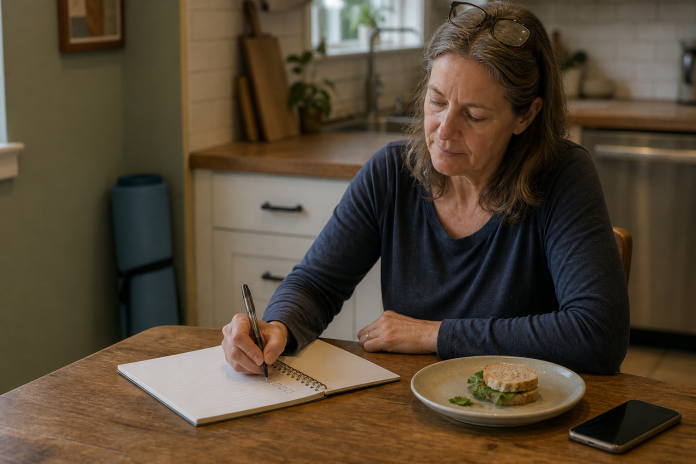
Woman at a kitchen table writing a seven-row checklist in a notebook, yoga mat rolled up behind her

Quick guide

This optional self-check uses seven chakra-inspired headings for a life review: safety, pleasure and creativity, agency, connection, expression, insight and meaning. It does not measure an energy centre, diagnose a blockage or assess your health. Spiritual interpretations vary between traditions and practitioners. Use the headings only if they help you reflect; low scores or physical symptoms are not evidence of chakra damage.

Respecting the chakra map

Chakra teachings belong to Indian contemplative and religious traditions, with differing systems and interpretations. The seven-area exercise below is a modern reflective adaptation, not a complete account of Hindu or Buddhist practice. Its colours and life themes are optional prompts, not anatomical facts or a test that can locate an illness.

The ten-minute self-check

  • 1. ListWrite the seven headings down the left of a page: Safety, Pleasure, Agency, Connection, Voice, Insight, Meaning.
  • 2. ScoreGive each a number from 1 (neglected) to 5 (thriving) for the last month. Go with your first answer.
  • 3. Pick oneChoose the lowest score. Only one. Write one sentence about what is actually going on there.
  • 4. ActWrite one small, dated action for that area. Re-score in a month.

Treat the scores as personal notes, not a validated health scale or a requirement to fix the lowest number. You can skip scoring and write a sentence instead. Pause if the exercise increases worry or self-criticism.

The seven areas, translated

Chakra-inspired prompt Life area Possible concern to explore A practical move
Root (Muladhara), base of spine, red Safety: housing, money, health, physical security Living in survival mode; constant low-level fear about the basics Choose one practical support step, such as asking for housing help, reviewing a budget or arranging a healthcare appointment.
Sacral (Svadhisthana), below navel, orange Pleasure and creativity: enjoyment, play, intimacy Everything is a chore; nothing is fun; creativity has dried up Schedule one pleasant, useless thing a week. Protect it.
Solar plexus (Manipura), upper abdomen, yellow Agency: confidence, decisions, follow-through Feeling powerless; putting off decisions; being pushed around Make one decision you have been avoiding, however small, today.
Heart (Anahata), centre of chest, green Connection: love, friendship, compassion, boundaries Isolation, resentment, no limits or walls everywhere Contact one person you miss. Set one limit with one person who drains you.
Throat (Vishuddha), throat, blue Voice: honesty, being heard, saying what you need Swallowing what you think; feeling ignored; talking without saying anything Consider one safe way to express a need. Do not confront someone if doing so could put you at risk.
Third eye (Ajna), brow, indigo Insight: reflection, judgement, seeing the pattern Fog; reacting rather than thinking; ignoring what you already know Ten minutes of journaling or quiet each morning for a fortnight.
Crown (Sahasrara), top of head, violet Meaning: purpose, wonder, belonging to something larger “What is the point?”; going through the motions Time in nature, in a community, in art or a practice that is bigger than you.

The signs that are not chakra signs

A life-review prompt cannot distinguish ordinary stress from a medical or mental-health condition. Do not label symptoms as a blocked chakra or let a spiritual explanation delay care.

Optional reflection

You might use the headings to explore a manageable decision, an interest you have neglected or a boundary you want to practise. Reflection is optional. Loss of enjoyment, hopelessness or difficulty functioning can also deserve professional attention; do not dismiss them as simply needing a small life change.

Seek appropriate support

Persistent, distressing or worsening symptoms, concerns about substance use or eating, panic, unusual beliefs that frighten you, and physical symptoms deserve appropriate professional assessment. NIMH’s help-seeking guidance includes severe or distressing symptoms lasting two weeks or more; seek help sooner when symptoms are severe or worsening. In the U.S., call or text 988 for crisis support. For immediate danger use local emergency services; outside the U.S., use local crisis support.

What “opening a chakra” actually involves

  1. Meditation with a focus point. You may use a colour or image as an optional attention prompt. Benefits vary, and some people find meditation distressing. NCCIH discusses both possible benefits and negative experiences. Stop or modify a practice that makes you feel worse; there is no need to force an altered state.
  2. Yoga. Some yoga practices may help with stress, balance or certain pain conditions, but effects depend on the person and method. The National Center for Complementary and Integrative Health discusses benefits, limitations and safety in its yoga fact sheet. Choose an appropriate level with a qualified teacher and avoid painful or unsuitable postures.
  3. Affirmations. Saying “I am safe” to yourself does not make it so, but naming what you want to be true can help you notice what would need to change.
  4. Crystals, essential oils, coloured foods and metal spoons on the feet. These are not established ways to open energy centres or treat illness. Do not assume they are harmless: small objects can be choking hazards, oils can cause irritation or other adverse reactions, and dietary changes may be unsuitable for some people. Avoid ingesting oils or adding risky products to a reflective exercise.
  5. Reiki or “chakra balancing” sessions. Some people find sessions relaxing, but that is not guaranteed. NCCIH says Reiki has not been clearly shown effective for a health-related purpose and that evidence does not support the proposed energy field. A practitioner’s blockage claim is not a medical diagnosis. Our safety guide covers how to keep such sessions in their lane.

Chakras and runes: two maps, same job

This site is mostly about runes, and the two systems are used the same way here: as structured prompts for reflection. A rune drawn in the morning gives you a theme; a chakra self-check gives you seven areas to score. Neither exercise is a validated measurement of spiritual energy or a reliable forecast. A notebook can help keep interpretations separate from practical facts. If you like the rune approach, our guide to the runes is the place to start.

Key takeaways

  • A chakra-inspired checklist is not a measurement of organs or spiritual energy.
  • Used honestly, the seven chakras are seven headings for a life review: safety, pleasure, agency, connection, voice, insight, meaning.
  • A low self-check score is a prompt for reflection, not proof of a blockage or a diagnosis.
  • Addiction, persistent low mood, panic, paranoia and chronic physical symptoms are not chakra problems; they need a professional.
  • Meditation and yoga may have benefits and risks; oils, objects and foods should not be assumed harmless or used as chakra treatments.

Frequently asked questions

1. Can chakras be measured?

There is no validated clinical chakra measurement used by this exercise. “Measuring up” means making personal notes about life areas, not detecting an energy centre or diagnosing health.

2. Are chakras real?

Chakras are meaningful concepts within contemplative and religious traditions. That cultural or spiritual meaning is different from demonstrating a measurable physical organ or energy field.

3. How do I know if a chakra is blocked?

This checklist cannot diagnose a blocked chakra. You can ask which area you would like to reflect on, while keeping health symptoms and safety concerns separate from spiritual interpretation.

4. Where do the chakra colours come from?

Colour associations depend on the teaching or system. The red-to-violet arrangement used here is a familiar modern presentation, not a universal rule or a health measurement.

5. How many chakras are there?

Seven is used in this exercise, but different traditions and modern teachers use different systems. Do not assume that every Hindu or Buddhist teaching has the same map.

6. Does chakra meditation work?

Some meditation practices may help some people, but effects vary and negative experiences can occur. This exercise does not demonstrate that meditation opens chakras; stop if it increases distress.

7. Can a blocked chakra cause illness?

There is no established basis for diagnosing illness as a chakra blockage. Physical or mental-health symptoms deserve appropriate assessment rather than an energy explanation.

8. Is addiction a sacral chakra problem?

No. Addiction is a medical and psychological condition with effective treatments. Talk to a GP or an addiction service.

9. Do crystals open chakras?

Crystals are not an established way to open chakras or treat illness. A stone may serve as a personal reminder, but keep small pieces away from children and pets and do not use crystal preparations as treatment.

10. Do purple foods help the third eye?

Food colour does not establish an effect on a spiritual third eye or psychic ability. Choose food for nutritional needs and preferences, with professional advice when needed.

11. Can a reiki practitioner balance my chakras?

Some people find a session relaxing, but Reiki has not been clearly shown effective for a health-related purpose. A chakra diagnosis should not replace medical assessment or justify changing treatment.

12. What is the crown chakra for?

In the map, meaning and connection to something larger. In practice: time in nature, community, art, faith or a discipline that is bigger than your to-do list.

13. How often should I do the self-check?

Choose a frequency that feels useful rather than compulsory; monthly is one option. Pause if scoring becomes a source of anxiety or reassurance-seeking.

14. What if every area scores low?

Low scores do not identify a cause. Consider practical support and speak with a healthcare professional if symptoms are persistent, distressing or affect daily functioning.

15. Is yoga necessary?

No. This reflection exercise does not require yoga. If you choose yoga, use suitable postures and guidance; benefits are variable and painful or unsafe practices should be avoided.

16. Can I open my third eye to become psychic?

There is no established method for turning a third-eye exercise into reliable psychic ability. Use it, if at all, as optional reflection rather than a way to discover hidden facts.

17. Are there dangers in chakra work?

Yes, depending on the practice. Meditation can be distressing, unsuitable yoga can cause injury, and oils or small objects can pose risks. Avoid replacing care, forcing altered states or paying to remove supposed blockages.

18. How do chakras relate to runes?

Runes and chakra teachings have different cultural histories. This page uses them only as separate possible prompts for reflection, not as evidence of a shared ancient system.

19. What is the eighth chakra?

Some modern systems use an eighth-chakra label, often above the head and associated with a higher self. It is a spiritual interpretation, not a detected anatomical structure.

20. What should I do first?

If the exercise feels helpful, write down the seven headings and choose one manageable action or support step. Skip scoring or stop altogether if it makes you anxious; urgent concerns need help, not a checklist.

Safety boundary: Do not change treatment or pay to remove a diagnosed spiritual blockage. If an exercise increases fear, stop and seek appropriate support.

Using Runes for Divination

Runes

Quick answer

To use runes for divination, settle on a clear question, draw one rune (or three) from a bag without looking, and use a meaning from your chosen rune guide as a prompt for reflection. Write down what you drew and what you decided. Treat the draw as an optional reflection prompt, not a reliable prediction or a substitute for practical information. The full alphabet, the meanings and the reading method are in our main guide: What are runes and how to use them. This page covers a daily one-rune habit and how to look after a set.

A daily rune in five minutes

  1. Ask one open question. Try “What could I pay attention to today?” rather than “Will X happen?” A symbol can prompt your own ideas; it cannot establish what will happen.
  2. Draw one rune without looking. You can use that draw as today’s prompt. There is no rule you must obey, but repeated draws until you get a reassuring answer can turn reflection into a checking habit. Stop if the exercise makes you anxious.
  3. Read the meaning, then translate it. Use the keyword as a modern reflective association, not an instruction from an outside authority. For example, Raidho (journey) might suggest “leave time to think before the meeting.” Choose a safe, realistic intention.
  4. Note it in one line. Date, rune, intention. In the evening add one line about what happened.
  5. Review monthly. After a few weeks, consider whether the habit is useful or worth keeping. A journal cannot prove that a rune caused an outcome or predicted it; note misses and ordinary explanations as well as apparent matches.

Looking after a rune set

Material Care Avoid
Wood Start with a soft dry cloth; follow the maker’s advice for the finish Soaking in water (it warps and can lift the paint)
Stone or ceramic Use a soft dry cloth first; use water only if the maker confirms the material, glaze and markings tolerate it Dropping on hard floors; chipped edges are sharp
Bone, antler, clay Dry cloth only; keep out of direct sun Soaking or unapproved products; porous or painted surfaces may be damaged
The bag Follow the bag’s care label; let it dry fully before storing the set Storing damp runes inside it

You may read that runes should be “cleansed” under moonlight or in river water before use. There is no evidence that this changes anything about a reading, and river water can damage wood and bone. If a ritual helps you pause, keep it optional and simple, such as a quiet minute with the bag in your hands. This is a personal preference, not proof of energy removal. Do not burn unknown materials or use a draw to make medical, legal or financial decisions.

Choosing a manageable routine

You do not need to read every day or buy a special set. Keep the exercise brief, stop if it becomes compulsive, and leave important decisions to relevant facts and qualified advice. If you are still choosing materials, our rune-set selection guide covers practical buying and making considerations.

Frequently asked questions

Do I need to draw a rune every day?

No. A daily draw is an optional routine, not a requirement. Use it only if it helps you reflect, and skip or stop it if it increases anxiety or checking.

Should I redraw a rune I dislike?

You are free to stop the exercise. Repeatedly drawing until you feel reassured can become a checking habit; one draw is enough for a brief reflection, and no symbol must be obeyed.

Can a daily rune predict what will happen?

Do not treat it as a reliable prediction. Use a meaning as an optional prompt, then compare your ideas with practical facts; apparent matches in a journal do not establish predictive ability.

Should I cleanse my rune set with water?

Only use water if the maker confirms the material, finish and markings tolerate it. A soft dry cloth is a safer starting point for many sets. Ritual cleansing is optional, not an established way to improve a reading.

PsychicOz Review: A Grounded Guide to Paid Readings

PsychicOz Reviews

Rune Healing service-path review · paid reading included · updated September 5, 2026

Make room for a fresh perspective

Bring a recurring theme, a quiet question or an intention for the month ahead. Explore PsychicOz readers whose methods interest you and make the conversation part of your own reflective practice.

We testedPaid-session flow and the observable service experience
We separatedHelpful communication from claims that cannot be verified immediately
We checkedCurrent offer language and the satisfaction-policy window
We preservedHistoric reader comments below this guide

What a paid reading can—and cannot—show

Our team completed a paid reading. That allowed us to assess practical matters such as connection, question handling, pace, clarity and whether the session stayed within the intended scope. It did not turn a prediction into proof, and we do not grade an advisor on supernatural certainty.

Settle

Write one main question, the minimum safe context and a firm spending ceiling before opening a profile.

Select

Choose by current format, availability, profile rate and communication style—not by a perfect-looking average alone.

Observe

Notice whether the advisor addresses the question, distinguishes possibilities from facts and respects the time limit.

Record

Save the receipt, duration, immediately checkable details and any future claim with its stated time frame.

A healing-aware boundary

“Healing” language can be comforting, but a commercial reading should not replace counselling, medical care or crisis support. We look for calm, non-coercive communication: no diagnosis, no threat of a curse, no insistence that repeated purchases are required, and no request to move payment off the platform. Our guide to warning signs in psychic readings explains why threats and pressure deserve attention regardless of an advisor’s claimed gifts.

Useful

Questions that help a visitor reflect on choices, boundaries or a conversation they control. The psychic-protection guide offers practical boundaries without treating spiritual imagery as a safety guarantee.

Not evidence

Warmth, confidence and specificity can improve a session without proving a future outcome.

Pause when

Fear, urgency, guaranteed reunion or guaranteed healing is used to encourage more spending.

Escalate when

A health, safety, abuse or financial issue requires an appropriate qualified professional.

A moment to regroup

Explore a theme that keeps returning to you

Sometimes a reading begins with a feeling or a pattern rather than a precise question. PsychicOz advisor profiles can help you find an approach for discussing that theme as personal reflection.

Name the pattern

Write what keeps catching your attention: a decision, a repeated conversation or a wish for a different routine.

Find a compatible approach

If symbolism or a particular tool matters to you, look for it in the advisor’s description and confirm its use.

Choose a small takeaway

Ask for a theme to reflect on after the session. A reading can accompany a personal ritual, but it is not treatment or a promise of healing.

Discover a reflective reader on PsychicOz →

Customer care within reach

If your paid PsychicOz reading does not connect satisfactorily, the Resolution Center gives you a place to explain what happened. Submit the request within 48 hours of finishing the session, or receiving the completed email reading. Any eligible reading may be considered, not only the first. Refunds, credits or another remedy depend on the review of your case.

Read PsychicOz’s satisfaction policy

Grounded FAQ

Does a paid test prove psychic accuracy?

No. It establishes that our team used the service and can report observable parts of that experience. Future predictions need time and clear criteria; some claims cannot be verified at all.

Is PsychicOz a healing or healthcare service?

No. Treat it as an entertainment and personal-reflection service. Medical, mental-health, legal and financial decisions need qualified professional advice.

Which price should I rely on?

The amount shown in your account, on the advisor’s current profile and at checkout. Introductory offers can be limited to eligible new customers and can change.

How should I read the comments below?

Look for specific, first-hand descriptions of format, pace, communication and cost. Comments are individual accounts, not a representative sample or proof of a promised outcome.

First-hand community feedback

Share an experience another visitor can use

5 based on 3 reviews

Only approved comments with a star rating count toward this average.

Choose 1–5 stars and describe your own experience. New visitor reviews wait for admin approval before publication.

Write a review

Read approved reviews and comments