Begin with one question and one rune
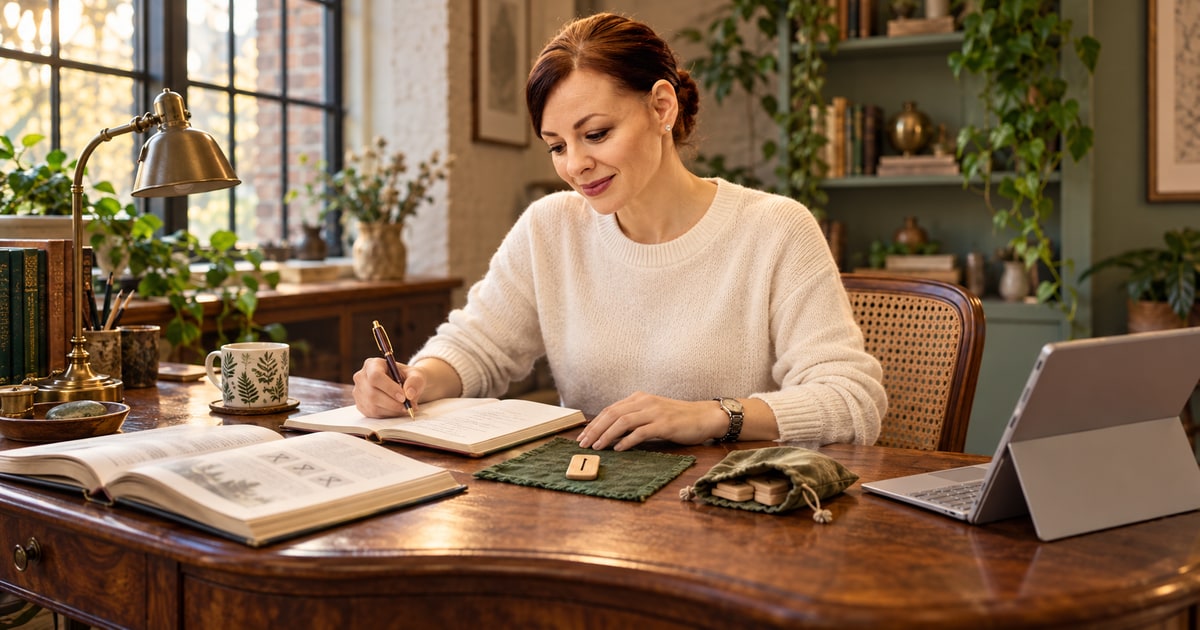
You do not need to memorise a whole book before you begin. If runes are part of your spiritual practice, a brief reading can give you a place to explore a question, notice an association and decide what you want to do next. Start with one rune and a notebook; larger spreads can wait.
The method below is frame, draw, notice, compare and act. You will find four modern layouts, an optional approach to reversals and a journal format. Keep interpretations separate from facts about the future or another person. If the alphabet is new to you, start with what are runes and how to use them, which has the full table.
What you can bring to a reading
People approach runes through spirituality, symbolism, study or a mixture of these. There is room for personal meaning without treating a draw as a factual forecast. A question such as “How can I prepare for this conversation?” keeps attention on your own choices; “What will they secretly decide?” asks a tile to supply information it cannot reliably establish.
This guide uses reading as an optional reflective practice: state the question, consider a symbol you did not deliberately choose, and give yourself a little time to think. Some people find that pause useful, while others do not. You can leave an interpretation undecided, check practical facts and stop when the exercise is no longer helpful.
A method you can repeat
- 1. Frame the questionWrite one “what” or “how” question about your own situation. Keep it low-stakes and specific enough to explore.
- 2. Draw without lookingTake one rune from a bag for a first check-in. If using a spread, decide its positions before drawing and record the order.
- 3. Notice, then consultWrite your first association. Then check a chosen guide and add its meaning separately, including the guide’s name so you can return to it.
- 4. Compare and actCompare possible interpretations with what you know. Choose one manageable action, or note that nothing useful emerged. Close the bag rather than redrawing for reassurance.
A note can be brief. Keeping your first impression separate from the reference makes it easier to see where each idea came from; it is not a test you have to pass.
Framing the question
Good questions are about you, are open, and could be answered by a thoughtful friend. “What am I not seeing about this move?” “How can I approach the conversation with my sister?” “What is my part in this pattern?” Questions that ask for a forecast (“will it rain at the wedding?”), another person’s private thoughts (“does he still love me?”) or a decision (“should I take the job?”) need information beyond a symbolic reading. Rephrase the last one as “What should I weigh up about the job?” Then list the pay, responsibilities, alternatives and other facts you still need.
Four layouts to choose from
These are modern reading conventions, not a ranking of accuracy. Choose the smallest layout that gives you enough room to reflect.
1. Single rune
- Positions
- One rune: the theme of the day, or the heart of the question
- Best for
- Morning check-ins; a quick pause before a decision
2. Three runes
- Positions
- 1 the situation as it is; 2 the obstacle or what you are not seeing; 3 a direction or advice. (Or past, present, direction.)
- Best for
- Most questions. See the three-rune reading for a worked example
3. Five-rune cross
- Positions
- Centre: you now. Left: what lies behind. Below: what supports or undermines you. Above: what you are aiming at. Right: one possible direction to consider, not a forecast.
- Best for
- A situation with history and momentum
4. Nine-rune cast
- Positions
- Cast nine onto a cloth. You may choose to use central runes as main themes, face-down runes as unknowns and touching runes as connected prompts. These are optional modern conventions.
- Best for
- A life overview; done rarely, with time to write
For this exercise, lay runes out in the order drawn and record their positions before moving them. This keeps your notes consistent; the pattern has no authority over your decisions.
The National Museum of Denmark describes the older alphabet as 24 characters. A blank tile is not one of those characters. The layouts here are modern reflective options, not a reconstruction of one universal ancient ritual.
Reversed runes
A rune that lands upside down is “reversed” or “murkstave”. Some readers take it as the blocked, delayed or shadow side of the meaning: Fehu reversed as resources leaking away, Wunjo reversed as joy withheld. Others ignore orientation entirely. Some carved forms look the same upside down; orientation rules vary with the shape and the guide. There is no universal count or required reversal system. Choose one policy and keep it; switching to whichever reading you prefer in the moment is the thing to avoid. For beginners, ignoring reversals for the first month keeps the meanings manageable.
Interpreting: from meaning to insight
The chosen guide’s meaning is the starting point, not the answer. Take Mannaz, “human”, drawn on a question about a team conflict. The keyword gives you “the self, community, shared humanity”. The insight comes from asking what that has to do with your question: perhaps that you have been treating a colleague as an obstacle rather than a person, or that you have been carrying the team’s problem alone. Write both possibilities. Compare each possibility with what you actually know. Discomfort does not make an interpretation true or tell you which action is safest. A rune that seems not to fit at all is also information: sit with the mismatch for a minute before discarding it, because “this has nothing to do with joy” is sometimes the a useful observation about what the prompt does not address.
For historical background, the museum explains rune names and which early forms are reconstructed. A name is not proof of every modern keyword attached to it.
Keeping a rune journal
- Date and question. Verbatim, at the top.
- Runes drawn, in order, with orientation if you read reversals.
- First impressions before the reference: two lines per rune.
- Reference meaning and where it added something.
- One action for the week.
- A month later: what happened, and did the reading help you think? Not “was it right”; “did it help”.
Include readings that felt unhelpful as well as those that resonated. Reviewing both can help you decide whether the practice supports your reflection or is becoming a source of pressure.
Common difficulties and better boundaries
Reading for prediction
Treating a rune as a forecast. It is a prompt. Do not use an apparent match as proof of prediction; look for misses and ordinary explanations too.
Reading about other people
Drawing on what an ex feels or a boss will do. A draw cannot establish their private thoughts. Bring the question back to what you can observe, ask or choose.
Redrawing
Pulling again until the rune is one you like. One draw per question, then close the bag. If checking feels hard to control or distressing, stop the exercise and seek appropriate support rather than setting yourself a compulsory schedule.
Outsourcing decisions
If a reading seems to tell you to leave, spend or commit, slow down. Use it to notice your feelings, then check options, consequences and relevant advice before making your own decision.
One further mistake belongs to paid readers rather than to you: a reader who finds a curse, a block or “negativity” in your runes and offers to remove it for a fee. No draw can show a curse. Pressure to buy a remedy is a reason to end the session; do not pay to remove a supposed curse.
Materials, briefly
Card squares with clear rune marks can be enough for a reflective exercise. Choose pieces that are comfortable to handle, within budget and safely sourced. A material does not establish special predictive power. For bone or other animal materials, species, provenance and wildlife rules can matter; do not assume the issue is only personal ethics. Check local rules and the maker’s sourcing information before buying or importing.
Key takeaways
- Frame, draw, hold, act: a question about you, a blind draw, meaning held against the question, two lines written, one action.
- Three runes (situation, obstacle, direction) handle most questions; the single rune is for daily check-ins.
- Pick one policy on reversals and keep it; beginners can ignore them for a month.
- Journal every reading and review a month later for whether it helped you think, not whether it was right.
- Do not treat a reading as a forecast, proof of someone’s thoughts or a reason to pay for curse removal. Pause if redrawing becomes distressing.
Frequently asked questions
1. How do I start reading runes?
Write a low-stakes question about your own situation, draw one rune without looking, and note what a meaning from your chosen guide suggests. Compare the idea with practical facts before choosing any action. There is no required daily schedule.
2. Which spread should a beginner use?
A single rune is a manageable start. Try three positions—situation, obstacle and possible direction—if more prompts are useful. Larger layouts add complexity, not proven accuracy.
3. Can I ask yes-or-no questions?
You can ask them, but a rune is not a reliable yes-or-no answer. An open prompt such as “what should I weigh up?” can leave more room for reflection; usefulness is not guaranteed.
4. What are reversed runes?
Some readers interpret an upside-down form as a blocked, delayed or shadow association. Other readers ignore orientation. Shapes and conventions vary; no reversal policy is compulsory.
5. What does it mean when the runes don’t fit my question?
You can note that it does not fit and move on. Do not force a connection or treat discomfort as proof. Not every prompt will be useful.
6. Do I have to memorise all 24 meanings?
No. Keep a reference guide nearby and learn at your own pace. Names and modern symbolic associations are not identical, and some historical names are reconstructed.
7. Should I meditate before a reading?
No. A quiet pause is optional and does not establish predictive accuracy. Skip any practice that makes you anxious or uncomfortable.
8. Can I read runes for someone else?
With consent, you can share prompts with a friend who makes their own interpretations and decisions. A draw cannot establish another person’s private thoughts or remove the need to ask them directly.
9. What is the blank rune for?
Some modern sets add a blank piece as an optional prompt for uncertainty. It is not a character in the 24-rune Elder Futhark alphabet, and you do not need to use it.
10. How do I know if I’m interpreting correctly?
Check the historical information against a reputable reference and compare your reflection with practical facts. A journal can track perceived usefulness, not prove that an interpretation is objectively true.
11. Can runes tell me about my past lives or my future?
Do not treat rune interpretations as reliable information about past lives or future events. They can be optional symbolic prompts, not factual evidence.
12. How often should I read?
There is no required frequency. Keep it brief if useful, and pause if repeated readings about the same worry increase distress or checking.
13. Is it bad luck to let someone else touch my runes?
There is no established reason to expect bad luck from another person touching a set. You can set handling boundaries for privacy, hygiene or protecting fragile pieces.
14. What if a reading frightens me?
Stop the exercise and focus on what you actually know. A frightening symbol is not evidence of danger or a curse. Avoid paid-remedy pressure and seek appropriate support if distress persists.
15. Can I combine runes with tarot?
You can combine them as optional symbolic prompts. Neither system establishes a factual forecast, and adding more symbols does not guarantee better insight.
16. Where do the rune meanings come from?
Historical names and surviving linguistic sources inform some associations; modern divination guides add their own interpretations. The National Museum of Denmark notes that some early rune names are reconstructed. Modern reading keywords should not be presented as identical to ancient definitions.
Keep the exercise in its lane: Do not use a rune to diagnose symptoms, change treatment or decide a high-stakes legal, financial or safety issue. Check relevant facts and seek qualified help when needed.
I appreciate the detailed instructions on how to conduct rune readings. The various layouts seem quite methodical and structured.
The breakdown of individual rune meanings and their applications is very useful. It helps in grasping the basic tenets of rune reading quickly.
The emphasis on avoiding runes made from animal bones is a significant point. It’s good to see a respect for natural laws in such practices.
This article provides a thorough overview of rune reading. It’s fascinating to learn about the different types and their historical significance.
The concept of interpreting runes based on one’s own intuition is intriguing. It seems like a deeply personal and introspective practice.
The historical context provided here is illuminating. Knowing that runes date back to 150 A.D. adds a layer of depth to their use in modern divination.
Absolutely, understanding their historical roots makes the practice even more meaningful.