Quick answer
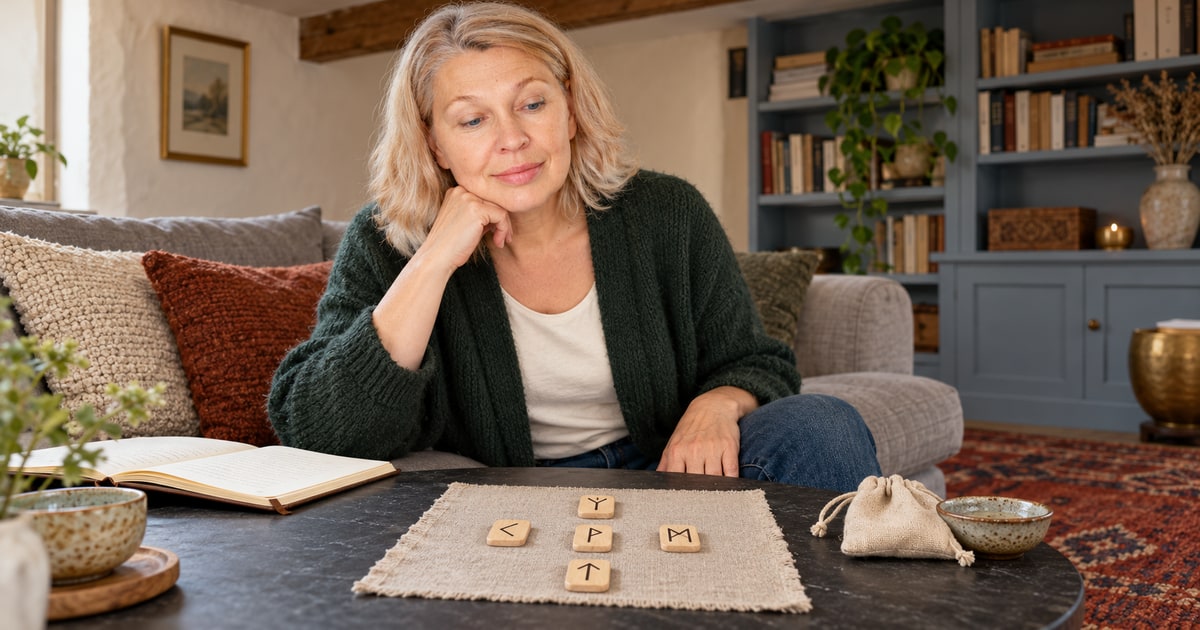
Using runes for divination means drawing one or more of the 24 Elder Futhark runes and using meanings from a chosen guide as prompts for thinking about a question. Treat the draw as optional reflection, not reliable information about future events. The full method, all 24 meanings and the three-rune layout are in our main guide: What are runes and how to use them. This page adds two things that guide keeps brief: reversed runes and larger layouts.
If reading runes is part of your spiritual life, a layout can give a quiet ritual a clear shape. It helps to separate the meaning you find in a symbol from the choices you can make afterwards. Choose the smallest layout that gives your question enough room; an elaborate spread is not a requirement for a meaningful reading.
Reversed runes: how modern readers handle them
Some modern readers treat a rune that lands upside down as “reversed” (merkstave) and give it a blocked or shadow version of its meaning. Reversal systems vary between modern guides. Some carved shapes look the same upside down, while others do not; do not rely on a universal nine-rune count. Orientation is an optional interpretation choice, not evidence that a theme is actually blocked. If you use reversals, keep them simple:
- Upright: you might explore the theme as a resource or possible direction, without assuming it describes a fact.
- Reversed: the same theme, delayed, blocked or overdone — read it as a question (“where is this stuck?”) rather than a warning.
- Beginners: you can ignore reversals while learning. Fewer prompts may be easier to manage, but there is no compulsory timeline or guaranteed benefit.
Choose a layout for your question
The positions below are examples you can write down before drawing, not universal rules. Rename a position if a different question fits better, but keep that wording for the whole exercise.
| Layout | Example positions | May suit |
|---|---|---|
| One rune | The theme of the day or a single question | Daily practice, journaling |
| Three runes | Past as you understand it · present concern · possible direction (or situation · challenge · advice) | A specific situation with one challenge to explore |
| Five runes | Past context · present concern · an overlooked possibility · options · a possible direction | A decision with several moving parts |
| Seven runes | 1–2: past context · 3–4: present concern · 5: what helps · 6: what hinders · 7: a possible direction | Reviewing a long situation |
| Casting (all runes) | Runes are scattered on a cloth; you may choose to read face-up runes near the centre, noting that this is one optional convention | Open-ended reflection; hard to interpret consistently |
A larger layout does not make a reading more accurate. It gives you more prompts, which some people find useful and others find distracting. More symbols do not establish a hidden fact or make a consequential choice for you. If a three-rune reading already covers the question, stop there.
Set the rules before you draw
- Write the question and positions. For “How could I approach this conversation?” try situation, challenge and a response you can choose.
- Decide about orientation. Note whether you will read reversals, and what you will do with a sideways or unclear piece. Simply treating it as upright is an option.
- Choose a stopping point. Make one brief note per position, then identify a practical next step. You can leave a confusing symbol unresolved rather than adding more draws.
Keep the rune, its position and your first interpretation together in your notes. Later, add what you learned from the real conversation. This makes it easier to notice where a symbol was personally helpful and where a different interpretation would have fitted just as well.
Keep the layout manageable
For a low-stakes question, one or three prompts may be enough. Our three-rune worked example shows how to separate symbolic interpretation from practical information. Stop if repeated draws increase anxiety or turn into checking; do not use symbols to diagnose symptoms, change treatment or decide a legal, financial or safety issue.
Frequently asked questions
1. Do I have to use reversed runes?
No. Some modern readers use orientation as an extra prompt, and others ignore it. Choose a consistent approach for your notes; an upside-down symbol does not establish a blocked energy or a threat.
2. Do larger layouts make a reading more accurate?
More runes give you more symbols to interpret, not proven predictive accuracy. Use a larger layout only if the extra prompts help, and stop if they add confusion or repeated checking.
3. What does an outcome position mean?
In this reflective approach it means one possibility to consider, not a forecast. Compare it with practical facts, alternatives and your own choices before acting.
4. Must I read every rune in a cast?
No. Decide which optional convention to use before the exercise, such as reading face-up pieces near the centre. The selection rule is a personal method, not a way to establish hidden facts.
The connections between runes and Norse mythology, especially the references to figures like Odin and Thor, add a mystical dimension to the practice.
The detailed explanation of each rune and its meanings, including the reversed states, is quite enlightening. I appreciate the depth of information provided.
It’s compelling how these ancient symbols can be interpreted in various ways, depending on their orientation.
Indeed, the reversal meanings add an extra layer of complexity that makes runes a fascinating tool for divination.
The segmentation of the alphabet into three parts, each symbolizing different life aspects, is a fascinating structure. It would be interesting to explore the linguistic evolution of runes further.
Absolutely, the trisection of the runic alphabet into Freyr’s Aett, Heimdall’s Aett, and Tyr’s Aett is highly symbolic and warrants further study.
The article provides a thorough historical context of the runes and their significance. It’s intriguing to see how ancient alphabets like the Elder Futhark are still relevant today.
The article is well-crafted, but it would benefit from additional information on how modern psychics integrate rune reading with other divinatory practices and their methodologies.
While the historical and mythological aspects are intriguing, I’m curious about the empirical evidence supporting the efficacy of rune reading in divination.