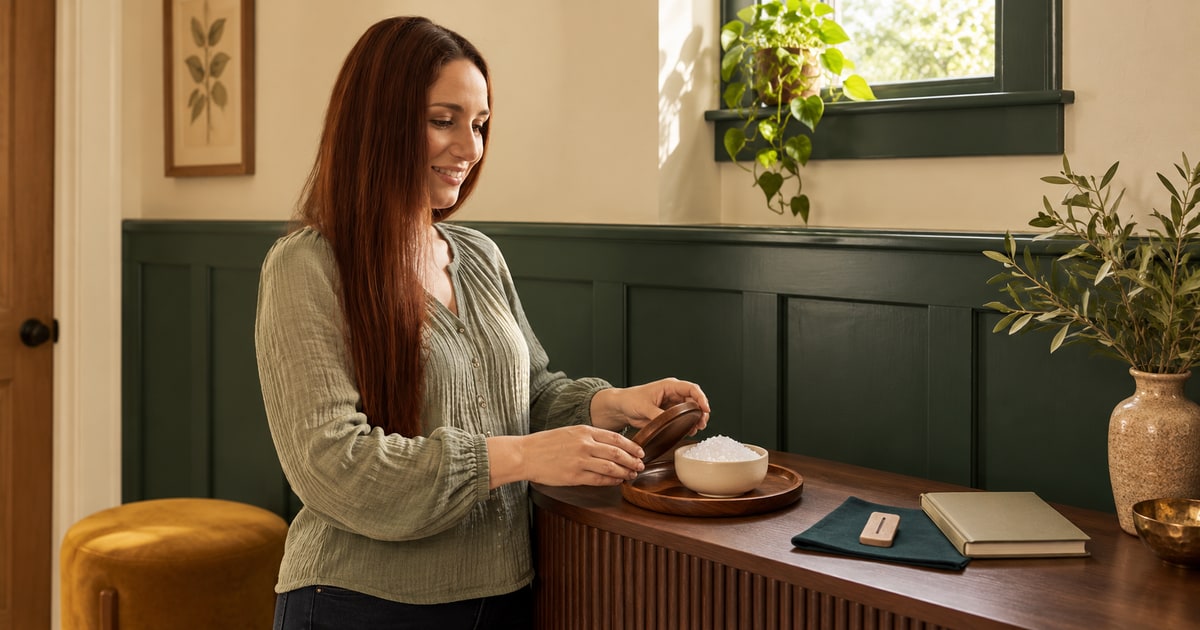
A small bowl, a quiet intention, a moment to welcome yourself home: simple objects can hold personal spiritual meaning. If salt belongs in your practice, let it mark the care you choose to give a space, rather than a rule you must obey.
Quick answer
Salt appears in some cleansing and protection traditions, but not every ritual or culture uses it. A bowl of salt can be a personal symbol of care for a space; it is not an evidence-based barrier against danger or unwanted “energy”. The five practices below are optional contemporary examples, not rules you must follow.
Why salt, of all things
Salt can carry associations with purity, preservation or protection, depending on the tradition and the person using it. Those meanings should not be collapsed into a single universal origin story. For one specific example, Japan’s Association of Shinto Shrines describes salt-water purification customs in a religious context. That documents a tradition, not proof of a medical or supernatural effect, and it does not make every modern salt ritual a Shinto practice.
Combining salt with rune tiles is a contemporary personal choice here, not a documented ancient requirement. Our guide to rune history and modern readings separates the historical alphabet from later spiritual interpretations.
How people use it today
A small bowl of salt in a room
Possible meaning: “This space is looked after”
Keep it contained and away from children and pets. Replace or dispose of it when dirty; its appearance is not a reading of the room’s energy.
A pinch in a pouch when travelling
Possible meaning: A pocket reminder of home and intention
Use a separate sealed container rather than placing salt against a rune tile. Algiz (ᛉ) has protection associations in some modern readings, not guaranteed protective power.
Salt in the bath
Possible meaning: Washing off the day
Salt is optional. Use a bath product only as directed, keep the water comfortably warm, and stop if irritation occurs. Do not put salt on wounds or drink the bath water.
Salt at a new home’s threshold
Possible meaning: Marking a fresh start
A contained symbol indoors avoids scattering salt on floors, metal fittings, soil or plants. Keep walkways clear and do not use salt as an actual security measure.
“Charging” salt overnight with a spoken intention
Possible meaning: Making a ritual deliberate
You can speak or write a practical intention, such as checking a lock or taking a rest. This does not establish that the salt gains energy or a protective force.
A fresh start after a tiring day
Imagine wanting to leave the day’s arguments at the door. You could choose a contained salt bowl as your reminder, or simply use an empty dish or a written note. The practical sequence is the same.
- 1. Name what you want to make room for
- “For the next half hour, I want less interruption and a quieter pace.” This is an intention, not a prediction that the room has changed.
- 2. Do one concrete thing
- Clear a small surface and put non-urgent notifications on pause, if doing so suits your responsibilities. Keep any salt covered and out of reach; do not put it on the floor or against rune tiles.
- 3. Finish without checking for a sign
- Put the object away when you are done. You can end the ritual even if you do not feel different. A later disagreement does not mean that you performed it incorrectly.
For your notebook: What matters to me here? What action supports it? When will I stop? You can keep the reflection and leave out the salt altogether.
What it cannot reliably do
Keep out someone who threatens you.
Salt cannot replace practical security, safe boundaries or specialist safety planning. Do not confront an unsafe person as part of a ritual; seek emergency help if there is immediate danger.
Diagnose or remove a curse.
A reader’s claim is not proof of a curse or attachment. Refuse pressure to buy urgent removal services. Our guide to psychic protection and practical boundaries explains the distinction between spiritual language and real-world safety.
Provide a proven detox or cure.
Poison Control notes limited evidence for bath-product detox and pain-relief claims and warns that ingredients can irritate skin. A ritual is not wound care or treatment for an illness.
Do not add salt to food or drink for spiritual protection. The NHS explains that too much dietary salt can raise blood pressure. Table salt and Epsom salt are different substances; bath products are not food. If someone swallows a concerning amount of salt or a bath product, contact your local poison service promptly. In the US, Poison Control is available at 1-800-222-1222; for collapse, trouble breathing or other immediate danger, call emergency services.
If a contained salt ritual feels meaningful, it can remain optional. It is not harmless in every setting, and you do not need to repeat it until a feared outcome feels prevented. Step away and seek support if the practice increases fear or becomes difficult to stop.
Key takeaways
- Salt’s spiritual meanings are tradition-specific or personal, not universal.
- Keep symbolic practices separate from medical care, security and material cleaning.
- Protect children, pets, surfaces and rune tiles from loose salt or unsuitable products.
- Choose a practical action to accompany an intention; no ritual guarantees an outcome.
Frequently asked questions
1. Does salt remove negative energy or curses?
There is no established evidence that salt removes a curse or creates a protective energy barrier. You may use it as an optional symbol, but do not pay someone who uses fear or urgency to sell curse removal.
2. Do all spiritual traditions use salt for cleansing?
No. Salt has specific uses in some traditions, and customs differ. The five practices here are optional contemporary examples, not a universal ritual or a reconstruction of an ancient rune practice.
3. Can I use salt to cleanse rune stones?
A symbolic container nearby is an alternative to direct contact. Salt, moisture and soaking can damage some materials; follow the maker’s care instructions and do not assume every stone, metal or wooden tile is safe to soak.
4. Is a salt bath a medical treatment?
A ritual bath is not a proven detox or a substitute for medical care. Use a bath product only as directed, stop if it irritates your skin, and never drink ritual salt water or bath products. Ask a clinician if you have a condition that may make bathing or a product unsuitable.
Note: “Energy” and “protection” describe spiritual interpretations here, not measured effects. You may skip any ritual; it should not replace practical safety or medical advice.
The article offers an interesting take on the spiritual uses of salt. It’s fascinating to see how something so common in our kitchens can have such versatile applications.
Barbara Moore’s insights on the connection between salt’s mundane and mystical uses are quite enlightening. I appreciate the practical advice on how to prepare and use salt for protection.
The recommendation to keep a bowl of salt in each room for energy balance is easy to implement. I’ll be interested to see if I notice any changes in the atmosphere of my home.
Moore’s suggestions for using salt in daily life are simple and accessible. It’s good to know that even without any special preparations, salt can still influence the energy of one’s home.
The concept of charging salt with a specific intention is intriguing. I wonder if there are scientific studies that explore the psychological impacts of such rituals.
The idea that salt’s protective properties come from its everyday uses, like food preservation, makes sense. It’s a practical approach to understanding spiritual tools.