

Quick guide
The four “clairs” — clairvoyance (seeing), clairaudience (hearing), clairsentience (feeling) and claircognizance (knowing) — are spiritual labels for claimed ways of receiving information beyond ordinary senses. Experiences described this way may also involve mental imagery, inner speech, bodily sensations or intuitive judgments. The label alone cannot establish their source. This guide offers observation, listening and reflection exercises, not a proven way to acquire psychic powers. Keep impressions separate from facts, and do not use them to diagnose illness or make high-stakes decisions.
The four clairs and everyday skills
| The clair | What it is claimed to be | Possible everyday experience | A skill you can practise |
|---|---|---|---|
| Clairvoyance (“clear seeing”) | Visions of distant or future events through the third eye | Visual imagination and mental imagery, which vary a lot between people | Observation, visual memory, noticing detail |
| Clairaudience (“clear hearing”) | Messages from spirits heard in the mind | Inner speech or remembered sounds; experiences differ between people | Listening and checking your understanding rather than assuming hidden meaning |
| Clairsentience (“clear feeling”) | Sensing energies of people, spirits and places in the body | Awareness of bodily sensations, which can have many emotional or physical causes | Reading faces, tone and rooms; knowing your own stress signals |
| Claircognizance (“clear knowing”) | Correct “downloads” of information from nowhere | A sudden hunch or insight that may draw on experience, but can be mistaken | Calibrated intuition: knowing when your hunches are reliable and when they are not |
Psychic research should not be reduced to “every test worked” or “no study ever found anything.” The CIA’s account of its remote-viewing program describes a 1995 evaluation that reported some results beyond randomness but judged the information too unreliable and inconsistent for intelligence use. That is not evidence that these four labels are proven abilities, or that a course can teach dependable extrasensory perception.
A checkable reflection method
- 1. RecordWrite a specific, low-stakes expectation before the outcome. Include a date, deadline and what would count as a miss.
- 2. CheckRecord what actually happened, without changing the original prediction to fit.
- 3. ReviewCount all outcomes, including misses and unclear results. Note ordinary clues and whether the outcome was common anyway.
- 4. AdjustLook for assumptions worth questioning. A few successes do not establish psychic ability or justify increasing financial stakes.
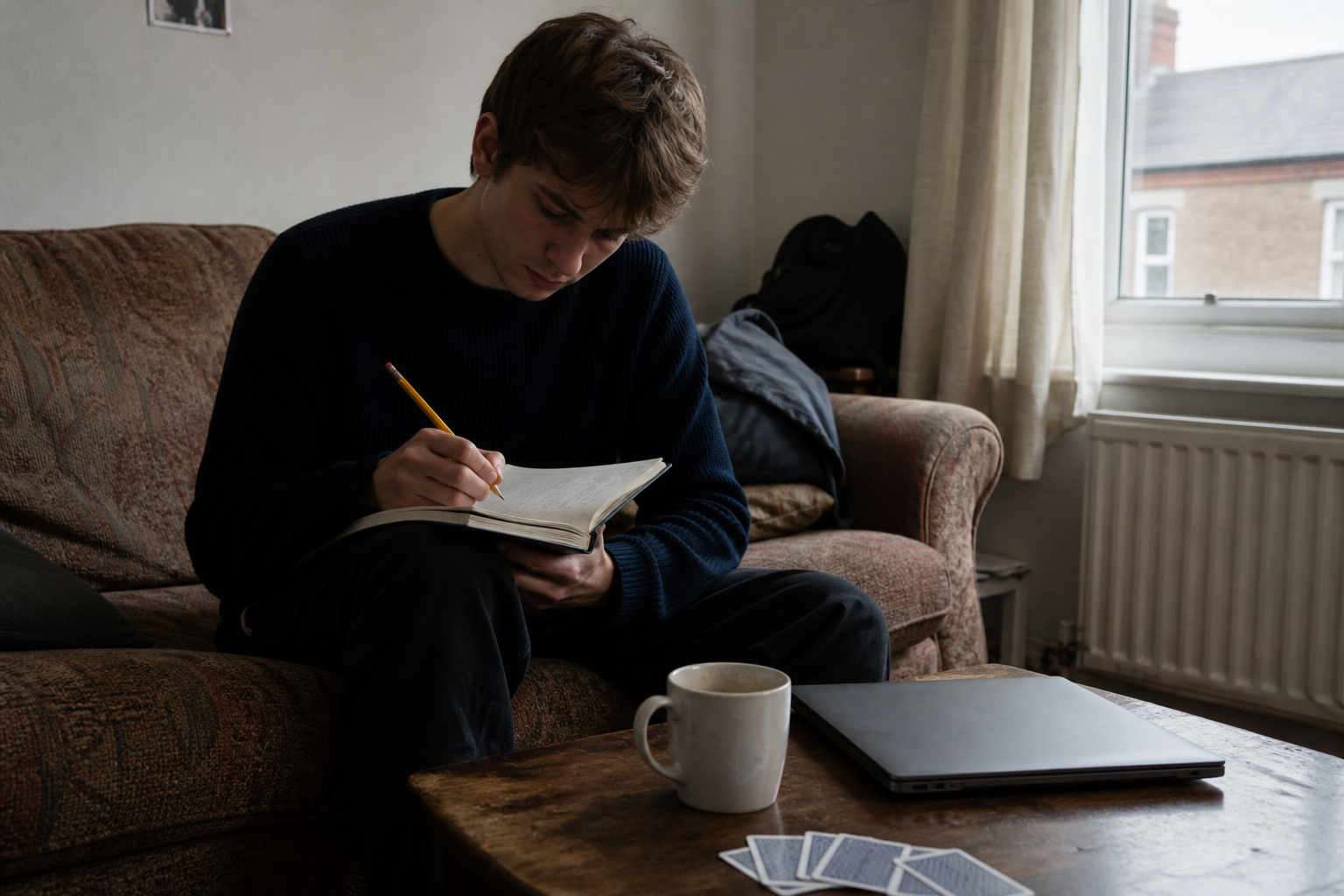
A notebook is a reflection aid, not a controlled experiment. Card guesses can be a low-stakes game, but shuffling, feedback, changing targets and selective scoring affect results. With one fair draw from a standard 52-card deck, a single suit has a one-in-four chance and one named card a one-in-52 chance; repeated trials need clearly defined conditions.
Why the journal matters
It is easy to notice a striking success and overlook less memorable misses. Record your expectation, the outcome and alternative explanations together. This can make your reasoning easier to review, but a journal does not eliminate every bias. If you expect a friend to call, consider their usual routine and whether you had already arranged to speak.
Exercises for each channel
- Seeing: the room test. Look around a familiar, safe room, then write down the details you remember. Return and compare. This tests recall and observation, not remote vision; there is no required time limit or guaranteed improvement.
- Hearing: the replay. After a conversation, separate the words you remember from your interpretation. If appropriate, ask the person whether you understood them. Do not assume you know an unspoken thought.
- Feeling: the body log. Briefly note a sensation and the surrounding situation. Consider sleep, food, stress and other ordinary factors. A sensation is not a verdict on another person’s character. Stop if monitoring increases anxiety, and seek care for persistent symptoms.
- Knowing: the calibration game. Give a low-stakes prediction a confidence estimate and compare it with the outcome later. Review enough similar predictions to see uncertainty; fifty entries is not a diagnostic threshold or proof of an ability.
- All four: optional quiet time. Try a brief, comfortable pause with eyes open or closed. The NCCIH meditation overview describes possible benefits and limitations, including reports of negative experiences. Stop if the practice is distressing, and do not substitute it for care.
The claims to leave behind
Do not treat symptoms as proof
No hunch is guaranteed correct. Headaches, dizziness or pain do not establish “energy sensitivity”; persistent or concerning symptoms need medical assessment. Voices that other people cannot hear may have different causes, not just one diagnosis. The NHS advises urgent medical help for hallucinations. If voices tell you to harm yourself or someone else, or there is sudden confusion or rapidly worsening symptoms, contact your local emergency service immediately.
Keep rituals optional and low-stakes
A stone, visualization or spiritual phrase may be personally meaningful. That does not make it a verified information source. Stay in safe, permitted places; do not enter abandoned buildings, lose sleep, spend beyond your budget or pressure someone into taking part.
Where runes fit
Runes can be optional prompts for reflection. Write what a symbol brings to mind, then distinguish your interpretation from observable events. Avoid assigning a vague symbol to every outcome and calling that a successful prediction. Our guide to learning rune readings offers a related symbolic practice; neither a draw nor a journal establishes predictive power.
If you are thinking of paying for readings
Listening and supportive conversation can have personal value, but warmth or apparent accuracy does not prove a supernatural source. Decide your budget before booking and keep medical, legal and financial decisions with qualified professionals. Our guide to assessing a reader’s conduct covers pressure and boundary concerns. A claim that a curse or blocked gift requires expensive treatment is a reason to end the interaction.
Key takeaways
- The four clairs are spiritual labels, not established explanations for every vivid thought or sensation.
- Observation, listening and reflection can be practised without claiming psychic powers.
- Record misses and ordinary clues alongside successes; a small informal test proves little.
- Keep rituals optional, affordable and separate from high-stakes decisions.
- Concerning symptoms and hallucinations need medical assessment, not psychic training.
Frequently asked questions
1. What are the four clairs?
Clairvoyance, clairaudience, clairsentience and claircognizance are commonly described as clear seeing, hearing, feeling and knowing. In spiritual usage they refer to claimed extrasensory experiences; the names do not establish how an experience arose.
2. Is everyone born with clair abilities?
People vary in mental imagery, inner speech, bodily awareness and intuitive judgment. That variation does not show that everyone has extrasensory abilities, and none of the exercises here can establish that you were born psychic.
3. Which clair is easiest to develop?
Begin with whichever ordinary exercise feels comfortable, such as noticing visual details or checking your understanding of a conversation. There is no established ranking for learning psychic abilities.
4. Does meditation open psychic abilities?
Meditation is not an established method for gaining extrasensory perception. It may be a personal attention or relaxation practice, but benefits and safety vary; stop if it causes distress.
5. I often think of someone and they call. Is that clairvoyance?
A coincidence does not identify its cause. Note your expectation before the call, count misses too, and consider ordinary routines or arrangements. A brief record cannot settle an extrasensory claim.
6. What is a good hit rate?
For one fair draw from a standard 52-card deck, a suit has a 25 percent chance and a specified card about 1.92 percent. Those baselines do not apply unchanged to every repeated game. A short above-chance streak alone is not evidence of psychic ability.
7. What does claircognizance feel like?
People may use the word for a sudden sense of knowing without a clear explanation. Treat that impression as a possibility, consider ordinary clues, and verify it rather than assuming it is accurate.
8. I hear a voice in my head. Is that clairaudience?
An ordinary thought in words is not proof of a spirit message. If you hear voices others cannot hear, seek urgent medical assessment. Voices urging harm, sudden confusion or rapidly worsening symptoms require immediate local emergency help.
9. I get headaches around certain people. Is that clairsentience?
A headache does not establish that you sensed someone’s energy. It can have different causes; recurring or concerning headaches should be assessed by a clinician rather than diagnosed through a spiritual label.
10. Do crystals help?
A crystal can have symbolic meaning or serve as a reminder to pause. That is not evidence that it transmits information or improves psychic accuracy. Do not use it instead of medical care.
11. Can I practise with a friend?
You can try a voluntary, low-stakes guessing game with clear targets and scoring agreed in advance. Keep all results and avoid feedback or accidental clues. An informal game is not proof of an ability.
12. What is cold reading?
Cold reading uses broadly applicable statements, observation and responses to create an impression of personal knowledge. A convincing conversation by itself cannot establish where the information came from.
13. Should I ask my spirit guides for clearer images?
If that spiritual language is meaningful, keep it optional. Treat any image or suggestion as something to reflect on and check, not an instruction you must obey or evidence of an external source.
14. Can developing these abilities be harmful?
Practice can become unhelpful if it increases anxiety, disrupts sleep or encourages spending and high-stakes decisions based on hunches. Stop if it is distressing. Do not interpret symptoms as an instruction to train harder.
15. Are dreams messages?
A dream can prompt reflection, but it does not reliably identify an outside sender or predict an event. Consider personal associations without treating the interpretation as fact.
16. How long until I see improvement?
There is no guaranteed schedule. You can review what you remember and whether your assumptions were accurate, but fifty predictions is not a validated threshold for improvement or psychic ability.
17. Do runes help develop intuition?
They can provide symbolic prompts for a journal. Whether that feels useful is personal; a rune draw does not establish predictive accuracy or demonstrate that intuition has improved.
18. Is it true that psychic ability runs in families?
A family tradition or similar experiences among relatives does not establish inherited extrasensory perception. Discuss shared stories without treating them as proof of a genetic ability.
19. Can I use these skills at work?
Careful observation and listening can be useful at work. Confirm assumptions, respect privacy and use evidence for decisions; do not label coworkers, clients or patients using untested impressions.
20. What should I do first?
Try one comfortable, low-stakes observation exercise. If you journal, separate what happened from what you guessed it meant, and keep room for uncertainty.
The article provides a comprehensive overview of different clair abilities. It’s interesting to see how these abilities are linked to our natural senses.
The practical tips for enhancing these abilities are well laid out. It’s nice to see an article that combines theory with actionable steps.
I agree. The idea of playing games to test these abilities makes the process more engaging and less intimidating.
While I’m skeptical about clair abilities, the methods suggested for developing them, like meditation and visualization, seem beneficial for mental focus.
I found the explanation of claircognizance particularly fascinating. The idea of ‘downloads’ of information is intriguing.
The connection between clairsentience and physical reactions was well explained, though I’m interested in seeing more empirical evidence on this topic.
It’s intriguing how these abilities are tied to everyday experiences like gut instincts and intuition. Makes you wonder about the untapped potential within us.