Quick guide
Reading runes is a four-step habit: frame a question about your own situation, draw runes blind, hold each rune’s traditional meaning against the question, and write down what you notice before choosing one action. Everything else (which spread, whether to read reversals, what materials) is preference. This guide gives the method in full, the four spreads worth knowing, a way to handle reversed runes, a journaling format, and the beginner mistakes that matter: reading for prediction, reading about other people, and drawing again until you like the answer. If you have not yet met the 24 runes, start with what are runes and how to use them, which has the full table.
What a reading is for
Older guides, including the earlier version of this page, describe rune reading as a way to tell the future and answer yes-or-no questions. It is neither. A tile drawn from a bag contains no information about next month, and “will I get the job?” produces a symbol that you will read as yes if you are hopeful and no if you are not. What a reading does well is different and worth having: it makes you state the question precisely, it hands you a symbol you did not choose, and it gives the problem ten quiet minutes. People come out of that clearer. That is the whole claim, and it is enough to justify learning the craft properly.
The method, every time
- Frame One question, starting with what or how, about your own situation. Write it at the top of the page.
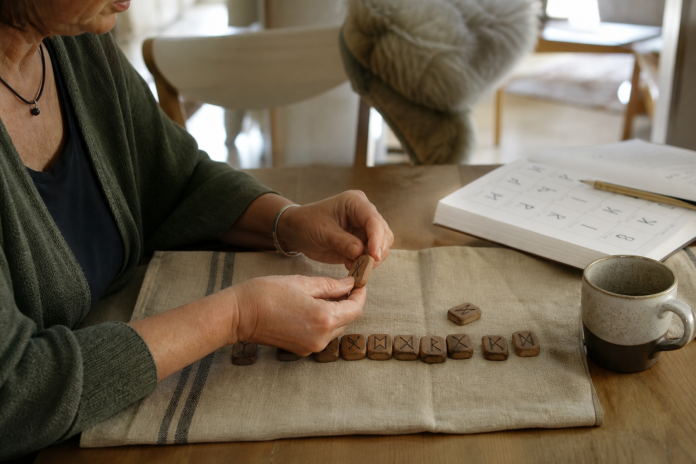
- Draw Blind, from a bag. One rune for a quick check-in, three for a situation, five or nine for something complex.
- Hold Each rune’s traditional meaning against the question. Write two lines per rune before consulting any reference.
- Act Note what the reading made you see, choose one action for the week, close the bag. Do not redraw.
The writing step is what separates a reading from a shrug. Skip it and the practice becomes fortune cookies.
Framing the question
Good questions are about you, are open, and could be answered by a thoughtful friend. “What am I not seeing about this move?” “How can I approach the conversation with my sister?” “What is my part in this pattern?” Poor questions ask for facts (“will it rain at the wedding?”), ask about other people’s minds (“does he still love me?”), or ask the runes to decide (“should I take the job?”). The last kind is the most tempting and the most damaging, because it hands a decision to a bag of stones. Rephrase it: “What should I weigh up about the job?”
The four spreads worth knowing
| Spread | Positions | Best for |
|---|---|---|
| Single rune | One rune: the theme of the day, or the heart of the question | Morning check-ins; a quick pause before a decision |
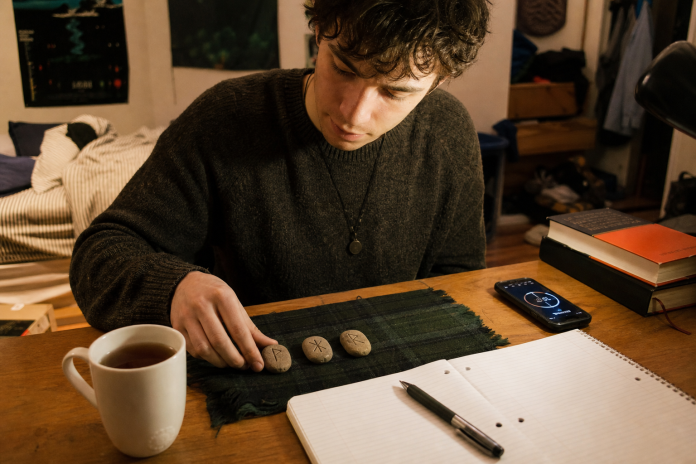
| Three runes | 1 the situation as it is; 2 the obstacle or what you are not seeing; 3 a direction or advice. (Or past, present, direction.) | Most questions. See the three-rune reading for a worked example |
| Five-rune cross | Centre: you now. Left: what lies behind. Below: what supports or undermines you. Above: what you are aiming at. Right: a likely direction if nothing changes. | A situation with history and momentum |
| Nine-rune cast | Cast nine onto a cloth. Runes near the centre matter most; face-down runes are unknowns; runes touching relate to each other. | A life overview; done rarely, with time to write |
Lay runes out in the order drawn and do not turn or move them once placed. Reading the pattern is part of the practice, and tidying it up removes what chance gave you.
Reversed runes
A rune that lands upside down is “reversed” or “murkstave”. Some readers take it as the blocked, delayed or shadow side of the meaning: Fehu reversed as resources leaking away, Wunjo reversed as joy withheld. Others ignore orientation entirely. Nine runes are symmetrical (Gebo, Hagalaz, Isa, Jera, Eihwaz, Sowilo, Ingwaz, Dagaz and, depending on the carving, Nauthiz) and cannot reverse. Choose one policy and keep it; switching to whichever reading you prefer in the moment is the thing to avoid. For beginners, ignoring reversals for the first month keeps the meanings manageable.
Interpreting: from meaning to insight
The traditional meaning is the starting point, not the answer. Take Mannaz, “human”, drawn on a question about a team conflict. The keyword gives you “the self, community, shared humanity”. The insight comes from asking what that has to do with your question: perhaps that you have been treating a colleague as an obstacle rather than a person, or that you have been carrying the team’s problem alone. Write both possibilities. Then ask which one you flinch at; that is usually the one to act on. A rune that seems not to fit at all is also information: sit with the mismatch for a minute before discarding it, because “this has nothing to do with joy” is sometimes the first honest thing said about a situation.
Keeping a rune journal
- Date and question. Verbatim, at the top.
- Runes drawn, in order, with orientation if you read reversals.
- First impressions before the reference: two lines per rune.
- Traditional meaning and where it added something.
- One action for the week.
- A month later: what happened, and did the reading help you think? Not “was it right”; “did it help”.
The last step is the one that makes the practice honest. A journal that only records hits is a scrapbook; one that records whether the reflection was useful tells you whether to keep going.
The mistakes that matter
Reading for prediction
Treating a rune as a forecast. It is a prompt. The moment you are waiting for the outcome to confirm the rune, the practice has become superstition.
Reading about other people
Drawing on what an ex feels or a boss will do. The bag cannot read anyone, and the answers are your hopes and fears with a symbol attached.
Redrawing
Pulling again until the rune is one you like. One draw per question, then close the bag. If you cannot, stop reading for a week.
Outsourcing decisions
“The runes said to leave.” They did not; you did, and it is better to know that. Use readings to notice how you feel about a choice, then choose.
One further mistake belongs to paid readers rather than to you: a reader who finds a curse, a block or “negativity” in your runes and offers to remove it for a fee. No draw can show a curse. Telling honest readers from dishonest ones covers the pattern.
Materials, briefly
Card squares with the runes drawn on are a complete set. If you want something nicer to handle, picking a rune set compares wood, stone, glass and bone. The earlier version of this page said bone sets are “against the law of nature”; that is a matter of personal ethics, not law, and many traditional sets were bone. Choose what you are comfortable with and can afford. The material affects nothing about the reading.
Key takeaways
- Frame, draw, hold, act: a question about you, a blind draw, meaning held against the question, two lines written, one action.
- Three runes (situation, obstacle, direction) handle most questions; the single rune is for daily check-ins.
- Pick one policy on reversals and keep it; beginners can ignore them for a month.
- Journal every reading and review a month later for whether it helped you think, not whether it was right.
- Never read for prediction, about other people, or by redrawing. Never let a reader find a curse in your runes.
Frequently asked questions
1. How do I start reading runes?
Write one question about your own situation, draw a single rune blind, write two lines on what its name makes you think before looking up the meaning, then read the meaning and choose one action. Do that daily for two weeks before trying larger spreads.
2. Which spread should a beginner use?
A single rune for the first fortnight, then the three-rune spread (situation, obstacle, direction). Five- and nine-rune layouts add complexity without adding much for most questions.
3. Can I ask yes-or-no questions?
You can, but the answer will be whatever you were hoping for or dreading, with a symbol attached. Rephrase as “what should I weigh up about this?” and the reading becomes useful.
4. What are reversed runes?
Runes that land upside down, read by some as the blocked or shadow side of the meaning. Nine runes are symmetrical and cannot reverse. Choose one policy and keep it.
5. What does it mean when the runes don’t fit my question?
Sit with the mismatch for a minute. Sometimes “this has nothing to do with joy” is the first honest observation about a situation. If it still does not fit, note that and move on; not every draw is illuminating.
6. Do I have to memorise all 24 meanings?
No. Learn the names first (they are ordinary words: cattle, gift, ice, sun) and let the meanings grow from them. Keep the table from our runes guide beside you.
7. Should I meditate before a reading?
A minute of quiet helps you frame the question and stops you rushing the draw. It is preparation, not a requirement, and it does not make the runes more accurate, because accuracy is not what is happening.
8. Can I read runes for someone else?
You can guide a friend through the method, with them framing their own question and doing their own writing. What you cannot do is read about a person who is not present.
9. What is the blank rune for?
Some sets include a 25th blank tile meaning “the unknowable”. It was invented in 1982 and has no historical basis. If you use it, treat it as “leave this question open”.
10. How do I know if I’m interpreting correctly?
There is no correct interpretation to check against. The test is whether the reading helped you think and act. A journal reviewed a month later answers that.
11. Can runes tell me about my past lives or my future?
No. They can prompt reflection on patterns you already carry. Anything presented as information about the past or future from a bag of tiles is the reader’s guess.
12. How often should I read?
One draw per question, and one question at a time. A daily single rune suits some people. Reading repeatedly about the same worry is a sign to stop and talk to someone instead.
13. Is it bad luck to let someone else touch my runes?
No. That is a superstition attached to tarot and borrowed by rune sellers. Your runes are pieces of wood or stone; handle them as you like.
14. What if a reading frightens me?
Write down the fear, close the bag, and remember that a symbol cannot know anything about danger. If a paid reader frightened you and offered a remedy for a fee, that was a sales pitch.
15. Can I combine runes with tarot?
Yes; some people draw a rune as the theme and a card as the detail. The method is the same for both, and mixing them is a matter of taste.
16. Where do the rune meanings come from?
From the runes’ names (Proto-Germanic words) and from three medieval rune poems, elaborated by twentieth-century writers. They are a tradition of interpretation, not historical definitions.
Ready for the three-rune reading?
A worked example, position by position, with a sample journal entry.
Evidence check: there is no evidence that rune casting predicts events; the account of why it helps as reflection follows what is known about framing, chance prompts and journaling. Historical points follow Britannica. Rune reading is an interpretive practice; nothing here is medical, legal or financial advice.