Quick Guide
Use runes for optional reflection—not diagnosis, treatment or proof of recovery. Historical healing stories describe beliefs; they do not validate medical claims.
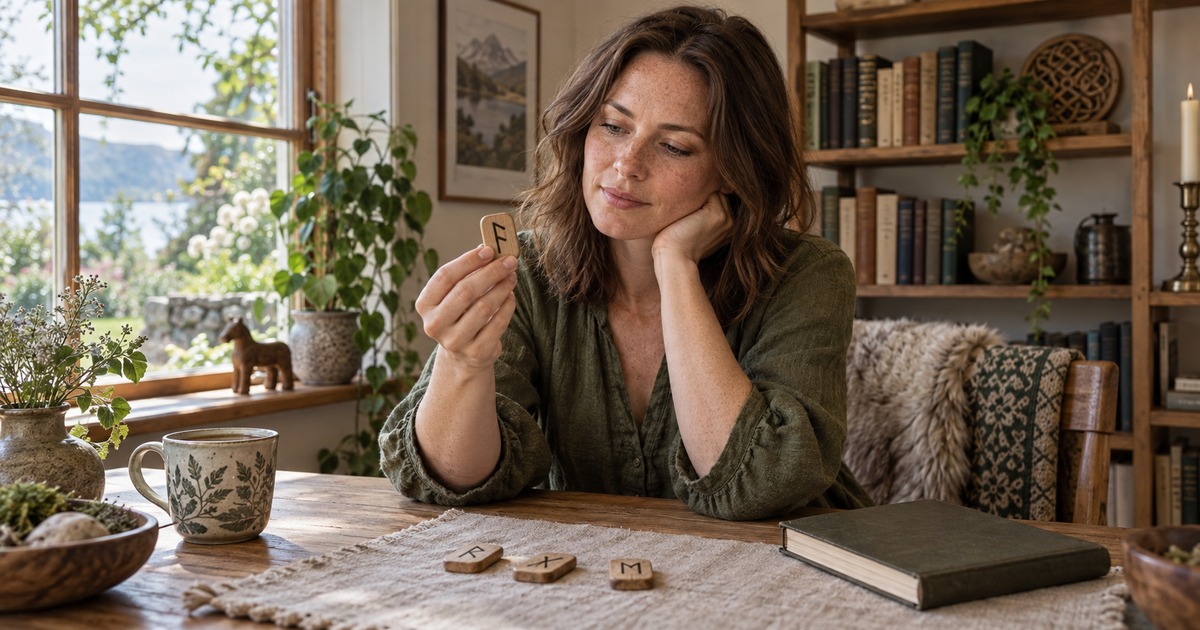
A small rune stone can have a lot of meaning, and you might hold a rune when you think about a hard time in your life, put it beside your dream journal, or draw a symbol when the words don’t come easily.
If you believe in psychic abilities, then runes might feel like a language where intuition speaks. This kind of experience can be personal, but it still sometimes asks the question, “Can runes heal?”
Runes can serve as spiritual tools, but they should not be used to diagnose or treat illness. Historical stories and objects document healing beliefs, not proof that a rune can cure illness.
You can explore spiritual meaning and dreams while keeping health decisions grounded in professional care. The best way to start is to be clear about what you want to change.
What is Rune Healing?
Healing is something that can be seen in different experiences. Physical healing is changes in the body such as a disease responding to treatment or a wound closing. Claims that a rune can cause these changes need medical evidence.
Emotional healing means finding ways to get more support, to find words for grief, or to be kinder towards yourself. A person might find that doing a rune ritual can help them, even though it doesn’t mean psychological treatment needs to be ignored.
Spiritual healing can mean having a new sense of purpose, connection, or trust. These experiences belong to a personal belief, and they can’t be judged in the same way as laboratory results.
Consider someone who has to go to a medical appointment. Holding a rune can remind them to write down questions and to bring a friend who supports them. The symbol plays a practical role in how they will prepare, and if their condition improves is a different question.
Writing down or saying your intention makes the practice easier to evaluate. If you need a quiet time to understand your feelings, then this is more practical than saying that the rune will remove the illness.
Traditions and Rune Healing
Runes were used as writing, and surviving inscriptions include ordinary communication as well as religious or magical language. Treating every rune as a spell loses that distinction.
The National Museum of Denmark describes a healing episode in Egil’s Saga involving replacement runes. It is a literary account of belief, not a medical record demonstrating a cure. Read the museum’s discussion of runic magic.
The museum also records the Ribe healing stick, whose inscription combines a healing charm with Christian religious language. The object documents a practice, not its clinical effectiveness. See the Ribe object record.
These examples show how people expressed hope during illness. Respecting that history does not require accepting its healing claims as medical fact.
Science and Rune Healing
The historical sources cited here do not establish that runes cure disease. This article is not a systematic review and does not claim to have tested rune healing. Organ-specific benefits, diagnoses and promises of recovery require clinical evidence, not testimony or symbolic associations.
Research on other practices cannot fill that gap. NCCIH’s meditation and mindfulness overview describes potential benefits for some outcomes alongside research limitations and possible negative experiences. Those findings cannot be transferred automatically to rune rituals, and such practices should not replace or delay conventional care.
If you feel calmer after a quiet ritual, that is a personal observation. It does not identify whether the symbol, the pause, your expectations or another part of the experience made the difference. Personal meaning and medical proof are different questions.
Letting Your Runes Play a Practical Role
One way that rune work can be useful is to ask what role the symbol plays in your life. Instead of trying to find a rune that promises a cure, focus on things you can do, such as have patience, support yourself, express feelings, or rest.
Here are some exercises that you can try that aren’t historical treatments or established meanings for each rune:
- Patience: Let a chosen rune remind you to respect your current limits.
- Support: Use another as a prompt to identify someone you can ask for help.
- Expression: Choose a symbol that invites you to name an emotion honestly.
- Rest: Give a rune the role of marking the end of your daily reflection.
If you follow a certain rune tradition and you can pick the symbols whose meanings fit into those themes within that practice, then write down the traditional meaning and your personal associations.
You might say, “My guide associates this rune with strength, and today I’m going to look at strength as letting others help me.” This small distinction keeps the interpretation strong but makes space for the idea that you need strength from others instead of doing everything alone.
Runes and Dream Interpretations
A reader who believes that dreams have psychic insight often believes that runes can give another way to look at an impression. It’s important to let the dream speak before you add an interpretation.
When you wake up, write down what you remember, including the place the dream took place, the people, actions, and feelings. If a rune shape appeared, write it down before you look at a reference. Write these three separate things down:
- The experienceWhat actually appeared in the dream?
- The interpretationWhat might it mean to you?
- The responseWhat reasonable action, if any, could follow?
If you dream of standing outside a locked house and you feel tired but the light in the window feels welcoming, you might want to look at what symbols of dreaming of a house mean, like privacy or unfinished conversations. If you pick a rune that is associated with support, you might ask yourself where you need more support in your life.
This allows for you to have insight without having to say that the dream has one fixed meaning. You might understand a dream spiritually, psychologically, or through other perspectives. A rune reading does not establish that a message came from a psychic source, and a dream image shouldn’t be used to diagnose an illness.
Dream Journal and Interpretations
One thing that you can do that leaves room for beliefs and uncertainty is writing down your dreams. See what runes you reflected on and write down two possible interpretations such as:
“Maybe this dream invites me to trust that support is available.”
“Maybe I have been feeling isolated and need more contact with people I care about.”
Look for an action that makes sense with either of the interpretations. You might talk to a friend, ask for practical help, or make time for a conversation that you put off. This gives the reading more value instead of trying to prove the origin.
You can also write down the word “unclear” beside a dream, and leaving a symbol unknown can be part of the interpretation.
An Easy Rune Ritual for Reflection
You do not need costly materials. Our guide to choosing a rune set concerns the tools for a spiritual practice, not objects with established medical effects.
You don’t need to do anything complicated to use runes as part of an easy reflection practice. This is just an easy exercise that you can use when you want to slow down, think about something that’s on your mind, or spend a little time focusing on yourself. It’s meant for personal reflection and isn’t a replacement for medical care or professional advice.
1. Think About Your Intention
Start by thinking about what you want to focus on during the ritual. You can keep your intention simple and make it something that fits what you’re dealing with right now. For example, you might say, “I want to notice what I need today,” or “I want to approach this situation with more patience.”
2. Pick One Rune
You can randomly draw one rune or deliberately pick one that feels right to you. You don’t need an expensive rune set or anything special to do this. You can even draw a rune on a piece of paper if that’s what you have available.
3. Get Comfortable
Find a comfortable place where you can sit quietly for a few minutes. Take a little time to notice what’s around you and let yourself relax without worrying about doing everything perfectly. You can breathe naturally and keep your eyes open or closed depending on what feels the most comfortable to you.
4. Ask an Open-Ended Question
Think about one question that you’d like to reflect on. You might ask something like, “What needs my attention right now?” or “What could make today a little easier?” Keep your questions focused on personal reflection instead of using a rune to diagnose a health condition or make decisions about medical treatment.
5. Write Down What Comes to Mind
Take a minute to write down one thing that came to mind while you were looking at the rune and one small action that you can take afterward. For example, your impression might be, “I keep thinking about needing some quiet time.” Your action could then be something simple like, “I’m going to give myself ten quiet minutes after my appointment.”
6. Finish Your Practice
When you’re ready, put your rune away and continue with your day. You don’t have to have a huge realization or feel like something dramatic happened for the practice to be meaningful. Sometimes simply giving yourself a few quiet minutes to think is enough.
If the practice ever makes you feel uncomfortable, you can stop whenever you want. Rune rituals like this are supposed to give you a little time for reflection, so you should always feel free to decide if you want to continue.
Help and Proof
Keep brief notes about what you did, how you felt and whether you took a useful action afterward. Record uneventful days too. Notice whether quiet time, writing or asking for help seems useful without assigning every change to the rune.
A personal journal is not a clinical experiment. Its purpose is to help you decide whether this optional practice fits your life, not prove that an object changes health outcomes.
Spiritual Care
A meaningful rune practice can leave room for uncertainty. You don’t have to keep picking a rune until you get a symbol or a signal, and if a reading feels scary, write down your response and then step away. A symbol should not be treated as a diagnosis or reliable prediction.
Illness does not mean that you are weak, lack belief or chose the wrong rune. Reject interpretations that blame you for being ill.
Be cautious about readers that guarantee recovery or claim to diagnose you through the runes. If a reader tells you that you need to buy repeated readings or pay to get rid of harm, avoid them. A psychic’s confidence should not be a replacement for medical professionals.
When physical symptoms, distress, or nightmares affect your daily life, talk to a professional for support. You can bring your spiritual values into the conversation, but you can also stay grounded in what you need.
The best kind of boundary is one that supports your choices, decisions, and lets you get help and ask questions.
From Symbol to Support
1. Name the feeling
What needs attention today?
2. Separate belief from evidence
A symbol is not a diagnosis.
3. Take a grounded step
Rest, ask for help or contact your clinician.
Key Takeaways
- Historical use is evidence of tradition, not a cure.
- Personal comfort does not identify a medical effect.
- Keep health decisions with qualified professionals.
- You may stop a ritual or decline a paid service at any time.
Related Reading
Explore choosing a rune set and the site’s three-rune reading guide as spiritual practices, not health assessments.
Frequently Asked Questions
1. Can runes heal an illness?
Runes are not established medical treatment. A meaningful ritual is not evidence that an illness has been cured.
2. What does rune healing mean spiritually?
Some practitioners use the phrase for reflection, comfort or a sense of connection. Those personal meanings are distinct from clinical outcomes.
3. Do historical healing charms prove that runes work?
No. They show that a belief or practice existed. They do not establish why someone recovered or whether an intervention worked.
4. Is there a best rune for healing?
There is no medically established healing rune. Choose a symbol for personal reflection, not as a prescription for a body part or condition.
5. Can I use runes alongside medical care?
An optional symbolic practice can coexist with care, provided it does not delay treatment or change medication decisions. Discuss any added substances or physical practices with your clinician.
6. Does mindfulness research prove rune healing?
No. Findings about structured mindfulness programs cannot automatically be applied to rune rituals.
7. Can runes diagnose a condition?
Do not use a rune reading to diagnose symptoms. A qualified health professional is the appropriate source of assessment.
8. Can a rune dream predict recovery?
A dream can feel meaningful but cannot establish your prognosis. Discuss recovery questions with your healthcare team.
9. Do I need psychic abilities?
No. Anyone can use a symbol as a journaling prompt without assuming psychic ability or predictive accuracy.
10. Do I need an expensive set?
No. A simple drawing is enough for optional reflection. Cost does not demonstrate spiritual or medical effectiveness.
11. How can I try a brief reflection practice?
Choose an intention, look at one symbol, name an emotion and select a practical action. Finish when you wish; there is no required result.
12. What if I feel nothing?
Nothing is wrong with you. You can stop, choose another reflective activity or leave the meaning unresolved.
13. What if a rune frightens me?
Pause the practice. A symbol is not proof of danger, and you do not need to buy another reading to neutralize it.
14. Which practitioner claims are red flags?
Guaranteed recovery, supernatural diagnosis, blame for illness and pressure to pay repeatedly to avert harm are reasons to step away.
15. When should I seek professional support?
Seek appropriate care for symptoms or distress that affect daily life. Urgent or severe symptoms require prompt medical help, not a rune interpretation.