

Quick Guide
Keep the roles separate: runes can be an optional reminder or reflection practice; diagnosis, medication, tests, and treatment require qualified healthcare guidance. Never delay urgent help to complete a reading.
On this page
Runes can still be part of your life during your illnesses, recovery, or stressful medical experiences. You can keep a rune journal, carry a symbol that reminds you of courage, or use a short reading to reflect on what kind of support you need. These uses concern personal meaning. Runes aren’t a method for diagnosing illness, picking medication, or treating a medical condition.
Using runes with medical care means keeping this difference clear. Your treatment decisions should be discussed with your healthcare professionals. Your spiritual practice can focus on values, emotions, and everyday actions that help you follow the care you agreed on.
You don’t have to pick between respecting traditions and asking medical questions. A good practice makes room for both. This guide gives original examples of how to do that without exaggerating what runes do.
Decide What You Want from the Practice
Before picking a rune, figure out what kind of help you’re seeking. If you want a moment of quiet before you make an appointment, this is different from wanting to know if a symptom is dangerous or not. The first is a personal ritual, but the second needs medical assessment.
A good intention can be “I want to remember to ask the questions I have clearly,” or “I want to remind myself that I’m allowed to accept help.” Neither of these needs the runes to identify a disease or predict a treatment.
Write down your boundaries so you can understand them. For example, this practice is for reflection, and I’ll use my doctor’s instructions when I make medical decisions. Keeping this note beside your rune can make it easier to pay attention when a reading starts drifting into medical advice.
The National Center for Complementary and Integrative Health advises against replacing or postponing conventional treatment with unproven approaches. Its guide to considering complementary health practices also encourages people to tell their healthcare providers about the approaches they use. The general safety principle applies even when a practice feels gentle or familiar.
Understanding Historical Runes
Runes were once a writing system and survived in inscriptions, including practical messages and materials that were associated with magic and religion. Their historical use is distinct from modern treatment claims. See our guide to rune traditions and evidence for that broader question.
The National Museum of Denmark describes stories of runic healing in the sagas, including an episode involving Egil and a sick young woman. Its account of runic magic provides cultural context. A literary account demonstrates that people told such stories; it does not establish clinical effectiveness. Our article on Egil’s Saga and rune-healing stories explores the historical context.
Modern rune practices can have historical material and recent interpretations. A symbol that was assigned a meaning by one person might be explained differently by another. This is why it’s important to ask where the interpretation comes from, not a reason to fear that picking the wrong stone is going to hurt you.
You can appreciate traditions without saying that every historical belief is a medical instruction. Reading a saga or studying an inscription are different kinds of evidence.
Use Symbols to Support Actions You Already Value
For example, imagine that Mira has a regular follow-up appointment coming up. She picks a rune that she personally connects with communication and puts a drawing of it beside the list of questions she wants to ask. Each time she sees the rune, it reminds her to mention a side effect that she has not really been talking about.
In this situation, the important part is that Mira talks to her healthcare provider about what she has been experiencing. The rune is simply something meaningful that helps remind her to do that. She is not using the rune to decide whether the side effect is serious or whether she should change the amount of medication she takes.
Someone else might connect a certain rune with patience while recovering from an injury or illness. They could put the symbol on a calendar where they keep track of exercises recommended by their care team. The rune can be a personal reminder to stay patient and keep going, while the actual instructions for the exercises still come from the professional who evaluated them.
One way to think about this is to ask if the action would still make sense even if the rune did not have any special power. Asking your healthcare provider a question, making sure you have a ride to an appointment, or following a care plan would still be helpful. On the other hand, deciding not to have a medical test because a rune made you feel like everything would be okay, could put your health at risk.
Keep Medical Questions Out of the Casting
Runes shouldn’t be used to decide whether you have a certain illness, whether a pregnancy is healthy, whether a medication is safe for you, or how long someone is going to live. These are questions that might require things like an examination, medical testing, and the knowledge of a qualified healthcare professional. A rune reading cannot provide that type of information.
If you find yourself wanting to ask a medical question during a rune reading, you can change it into a question about support instead. Instead of asking, “Should I stop taking this medicine?” you could ask, “What can help me talk about my concerns with the person who prescribed it?” Instead of asking, “Will my test results be normal?” you might ask, “What can I do to make the waiting easier?”
Changing the question does not mean that you have to ignore your feelings. It just gives you a safer and more useful way to deal with them. If you are worried about side effects, you can talk with your healthcare provider about the possible benefits, risks, other options, and what symptoms you should watch for. If you are nervous while waiting for test results, you might spend time with someone you trust, make sure you know who to contact with questions, or ask for help with everyday things if you need it.
A reassuring rune reading should also never take the place of medical advice when you develop new symptoms or have been told when to seek help. If you believe you are having a medical emergency, contact emergency services right away. You do not need to do another rune reading or finish a spiritual ritual before getting the help you need.
Rituals Before Appointments
A good routine can take just a few minutes. Put your medication list, appointment details, and questions together before you introduce spiritual elements. Preparing should be useful even when you don’t feel like doing a ritual.
Pick a symbol, or just look at one you already know, and ask yourself, “What do you want to communicate today?” Then write one plain sentence to respond to it.
Add the sentence to the top of your appointment notes. If you want to sit quietly for a few moments with your feet supported and your attention on the room, do this. You don’t have to fast, use incense, or go to a special state of consciousness to do this.
After the appointment is over, record the instructions separately from your rune reflections. This stops symbolic interpretations from becoming mixed with your medical plan. If something seems unclear, talk to your medical team instead of getting another reading.
A Care-First Appointment Routine
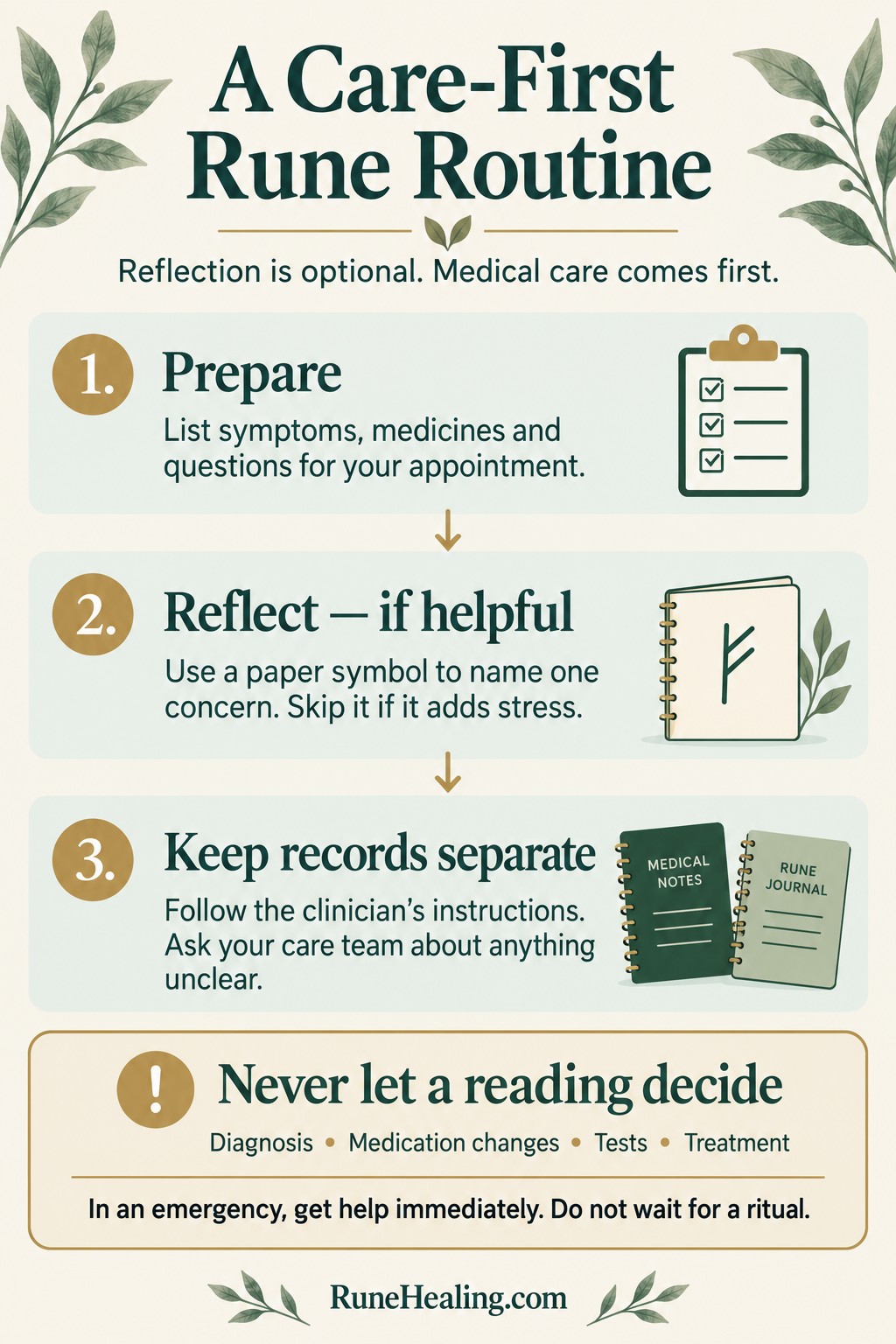
Gather medication details, symptoms, appointment information, and questions.
Use a paper rune or brief journal prompt to identify one concern you want to raise. Skip it if it adds stress.
Write the clinician’s instructions separately from symbolic impressions. Clarify uncertainties with the care team.
Check Materials and Physical Safety
A rune drawn on paper avoids practical issues associated with ritual materials. Small stones can be choking hazards for small children or pets. Sharp carvings or unknown materials can cause problems.
Never swallow the rune stones, drink water that has unknown stones or metal, or put unverified creams on wounds. A ritual label doesn’t tell you if a substance is safe for the body or not. If a practice includes herbs, supplements, oils, or other things, always check with the pharmacist or doctor before you use them medically.
The NHS explains that complementary therapies and herbal products can be unsuitable for some people and can interact with existing care. Its overview of herbal medicines and complementary therapies is a useful starting point for those additional products. It should not be read as evidence that rune casting treats illness.
In a hospital or clinic, follow the rules about belongings, infection control, fragrances, flames, and devices. Ask if a small paper symbol can stay nearby if it’s comforting to you. The staff can help identify what works in the care environment.
Talking to Your Doctor
You don’t have to give an explanation of your spiritual outlook to your doctor, and a good description makes the conversation easier. You can tell your doctor you use rune cards for journaling and that you’re not changing your treatment because of them.
If your practice includes physical products or procedures, talk about them specifically. A spiritual remedy is not enough information when you need to tell the exact supplement name, ingredients, frequency, and amount. Bring the packaging if you can.
You can also explain what you want the practice to give you. Maybe it gives you a familiar routine before you go to your appointments or a way to talk about your fear. A clinician doesn’t have to share the same belief as you to understand that purpose.
If you feel that your doctor is dismissing you when you tell them these things, tell them that you understand that runes are not a part of the treatment. If there’s anything about the materials or routine that conflicts with your care, this allows the discussion to stay focused on safety instead of speaking about your personal faith.
Setting Boundaries for Readings
Before you book a rune reading, ask if the reader gives medical predictions or advises people about medication. A good reader should be able to explain that their service doesn’t replace medical assessments.
If someone claims that runes reveal hidden cancers, guarantee cures, or prove that your doctor is wrong, be cautious. This also applies to claims that the treatment blocks your spiritual development or that your illness comes from moral failure. These are statements that create fear, and they have no medical basis for what they’re saying.
Consent When Supporting Someone Else
You might want to draw a rune for someone you care about when they are sick or going through a difficult time. If you plan to involve them in the reading, tell them what the rune means, put spiritual objects in their room, or share information about their condition with a reader, it is important to ask them first.
Someone can appreciate that you care about them and still decide that they do not want to be involved in a spiritual practice. They might be tired, have different beliefs, or simply want a different kind of support. Saying no to a spiritual practice does not mean that they have given up hope or that they do not appreciate what you are trying to do for them.
Another option is to use the runes to think about your own actions. Instead of asking what is going to happen to the other person, you could ask something like, “How can I be more supportive right now?” The reading might encourage you to bring them something to eat, keep your visit shorter if they are tired, or simply ask what they need. This keeps the focus on what you can do instead of trying to predict what is going to happen with someone else’s health.
It is also important to be careful about telling someone that a difficult rune means their condition is going to get worse or that a positive rune means they are definitely going to recover. Either message can create more stress for someone who is already dealing with uncertainty. You can offer love, comfort, and companionship without making a prediction about what is going to happen.
When a Reading Becomes Upsetting
Some runes are connected with ideas like change, disruption, or endings, which can feel especially scary when you or someone you love is dealing with an illness. Remember that rune meanings can be broad, and different people can interpret the same symbol in different ways. Drawing a certain rune does not automatically mean that something bad is going to happen to your body.
If you notice that you keep doing readings because you need reassurance, or you start seeing ordinary feelings in your body as proof that a reading is coming true, it might be helpful to put the runes away for a while. Focus instead on the things you actually know, such as your appointments, the information you have been given, and the people you can contact when you have questions.
You can also separate the feelings caused by the reading from the practical situation. For example, you might write, “This reading made me feel afraid.” Then you could write, “My next medical step is the follow-up appointment that is already scheduled.” Both statements can be true at the same time without the fear caused by the reading changing what you need to do next.
If the worry starts affecting your sleep, everyday activities, or your ability to follow your care plan, talking with a qualified health professional can help. Getting support for anxiety does not mean that you have to give up your spiritual beliefs. Instead, it can help you find a balance where your spiritual practices continue to have meaning without causing more fear or stress.
When You Can’t Do the Ritual
Things like illnesses or recovery time can interrupt routines. You might be away from your belongings, too tired to journal, or just uninterested in spiritual practices on that day. This doesn’t mean you’ve weakened your chance of recovery.
If you want an alternative, keep it simple. You can put a sentence in your phone, remember a word or a conversation with someone supportive, or use a physical object. This can have the same personal purpose as handling a rune. The physical object doesn’t have to be there for you to ask for help or to say that it’s valuable.
When routines are demanding, a person starts feeling that they have to draw the correct rune before they take their medicine. The ritual is starting to interfere with their care. They can stop using it around medication and talk about anxiety with a professional.
Having a flexible practice allows you to meet your needs. It shouldn’t add more stress or instructions to already complicated treatments. It also shouldn’t make you blame yourself if the symptoms change.
Final Thoughts: Having a Personal Plan
Keep a small agreement with yourself: Runes can prompt reflection, and medical decisions need a qualified professional. Add the contact details and the instructions that your medical team has given you, especially guidance about symptoms.
Pick a spiritual practice that you like and that’s low-risk, such as drawing a symbol in your journal. If you feel stressed, take a break and then go back to it later. Being consistent is optional, and you’re not failing your spiritual practice if you need a rest.
Pay attention to the effects as time goes on. Does the ritual help you prepare questions and accept support, or does it make you afraid or feel preoccupied? This kind of observation is useful when you’re deciding if you should continue, rather than promising that the practice has to work if you believe in it enough.
Spirituality and care have clear roles. You can let runes express meaning, hope, or intention, but you should let medical assessments guide and treat you. Your health doesn’t have to depend on interpreting each symbol the right way.
Key Takeaways
- A rune reading cannot diagnose illness or determine medication safety.
- A ritual must never delay emergency help, testing, or agreed care.
- Check herbs, oils, supplements, and physical materials with a qualified professional.
- Ask permission before involving someone else, and stop a ritual that increases distress.
Frequently Asked Questions
1. Can I use runes while receiving medical treatment?
You may choose a low-risk reflection practice, provided it does not replace, delay, or interfere with care. Discuss any products or procedures with your healthcare team.
2. Can rune casting tell me what illness I have?
No. Symptoms require appropriate medical assessment; rune interpretations are not diagnostic information.
3. Should I change medication after a reading?
Do not start, stop, or adjust medication based on runes. Discuss concerns and possible changes with the prescriber or pharmacist.
4. What is a safer question to ask?
Ask what could help you prepare questions, accept support, or communicate a concern, rather than asking runes to make a medical decision.
5. Can a positive rune mean I can skip a test?
No. A reassuring interpretation does not replace a test or follow-up recommended by your care team.
6. What if a rune seems frightening?
A symbol is not a medical prognosis. Set the reading aside, return to information you can verify, and contact a professional about health concerns.
7. Do historical healing stories prove runes work?
No. Stories and inscriptions document cultural beliefs and practices, not clinical effectiveness.
8. What is a simple pre-appointment ritual?
Prepare your medical notes first, then optionally use a symbol to identify one concern you want to discuss. Keep it brief and easy to skip.
9. Is a drawn rune enough?
Yes, for a personal reminder. You do not need special stones, a paid ritual, fasting, incense, or an altered state.
10. Can I drink water prepared with rune stones?
Do not ingest unknown stones, metals, or substances placed in water. Symbolic use does not establish material safety.
11. Should I tell my doctor about the practice?
Explain any relevant practices clearly, especially supplements, oils, herbs, or procedures. Specific names, ingredients, and amounts help the clinician assess safety.
12. Can I bring rune objects into a hospital?
Ask staff first and follow rules on belongings, infection control, fragrances, flames, and devices. A paper symbol may be a simpler option.
13. Can I perform a reading for someone who is ill?
Ask their consent before involving them or sharing their health information. You can instead reflect privately on how to offer practical support.
14. What if I feel compelled to cast before taking medicine?
If the ritual delays or interferes with care, stop using it around medication and discuss the anxiety with a qualified professional.
15. What should happen in an emergency?
Contact local emergency services immediately. Do not wait for a reading, another symbol, or the completion of a ritual.