Quick guide
Runes are the letters of the alphabets used by Germanic-speaking peoples from around the second century CE until the Middle Ages. The earlier Elder Futhark alphabet has 24 characters, each with a name that is also a word (cattle, gift, ice, sun) and, in modern practice, a cluster of meanings drawn from those names and from the Old English and Norse rune poems. Reading runes today means drawing one or more tiles in response to a question and reflecting on the meanings; it is a structured way to think, not a way to see the future. This guide covers the real history, the full 24-rune table, an optional reflective method, and a first reading you can do tonight with paper and a pencil.
Where runes actually come from
Runes were writing systems, not originally a single deck of divination symbols. The National Museum of Denmark’s Iron Age overview describes an earlier alphabet of 24 characters and later reduction to 16. Surviving inscriptions on objects include personal names, ownership marks and makers’ inscriptions. Runic alphabets changed across places and periods; the Younger Futhark is associated with the Viking Age, while Anglo-Saxon futhorc developed additional letters.
Historical writing, accounts of magic and contemporary rune readings should not be treated as interchangeable. Evidence of a past belief is not proof that a symbol predicts events or cures illness. Today’s guidebook interpretations and spread rules differ between authors. A blank tile appears in some modern sets, but it is not a letter of the historical Elder Futhark.
How a rune reading actually works
- A question Framed as “what” or “how” about your own situation. Keep the question low-stakes and within your control.
- A draw One to three runes taken blind from a bag. A random draw offers a theme you did not deliberately select, but interpretation can still reflect your expectations.
- A meaning The name and modern interpretive themes below, considered alongside the question.
- Your thinking What the pairing of question and symbol makes you notice. That is the reading; the tile only prompted it.
Treat the result as your interpretation, not hidden knowledge. Check proposed actions against facts, consequences and appropriate advice.
The Elder Futhark: all 24 runes
The National Museum’s rune-name guide explains reconstruction from later evidence. Spellings and translations vary. The table distinguishes commonly used names from modern reflective associations; related meanings from different alphabets are not exact equivalents. Read the last two columns as optional prompts, not predictions.
| Rune | Name / related translation | Reflective meaning | A question it raises |
|---|---|---|---|
| ᚠ Fehu | Cattle, wealth | Resources, what you have to work with, wealth that must move to be useful | What do I actually have, and am I using it? |
| ᚢ Uruz | Aurochs (wild ox) | Raw strength, health, untamed energy, endurance | Where is my strength going? |
| ᚦ Thurisaz | Giant; thorn in a related later tradition | Force, conflict, defence, a hard edge; caution before acting | What am I about to push against, and should I? |
| ᚨ Ansuz | A god; related later forms vary | Speech, communication, advice, inspiration, a message | What needs to be said, or heard? |
| ᚱ Raidho | Ride, journey, wheel | Movement, travel, the right order of things, progress | What is the next step, in order? |
| ᚲ Kenaz | Torch, ulcer (two readings) | Light, knowledge, craft, insight; also something that festers if ignored | What do I now see clearly? |
| ᚷ Gebo | Gift | Exchange, generosity, partnership, obligations that come with gifts | What am I giving, and what am I owed or do I owe? |
| ᚹ Wunjo | Joy | Contentment, harmony, belonging, a wish fulfilled | What is already good here? |
| ᚺ Hagalaz | Hail | Disruption, a setback outside your control, a storm that clears | What has hit me that I could not have prevented? |
| ᚾ Nauthiz | Need, necessity | Constraint, hardship, the pressure that forces a solution | What is the real need underneath the want? |
| ᛁ Isa | Ice | Stillness, a standstill, frozen feeling, waiting | What is stuck, and does it need to thaw or to wait? |
| ᛃ Jera | Year, harvest | Cycles, reward for patient work, the right season | What have I planted, and is it harvest time yet? |
| ᛇ Eihwaz | Yew tree | Endurance, resilience, connection between depths and heights, transformation | What will outlast this? |
| ᛈ Perthro | Uncertain (perhaps a dice cup) | Chance, the unknown, hidden things, luck | What can’t I know yet, and can I act anyway? |
| ᛉ Algiz | Elk (reconstructed; interpretation debated) | Protection, boundaries, alertness, a guarding stance | What needs protecting, and from what? |
| ᛊ Sowilo | Sun | Success, clarity, vitality, energy directed to a goal | Where is the light in this? |
| ᛏ Tiwaz | The god Tyr | Justice, courage, sacrifice for a principle, leadership | What principle matters here, and what are the consequences? |
| ᛒ Berkano | Birch | New growth, birth, nurture, beginnings | What is just starting that needs care? |
| ᛖ Ehwaz | Horse | Partnership, trust, movement together, loyalty | Who am I moving with? |
| ᛗ Mannaz | Human | The self, community, shared humanity, awareness | What do I share with the people in this? |
| ᛚ Laguz | Water, lake | Flow, emotion, intuition, the unconscious | What am I feeling that I have not said? |
| ᛜ Ingwaz | The god Ing | Potential, gestation, inner work before outer results | What is growing quietly? |
| ᛞ Dagaz | Day | Breakthrough, dawn, balance between opposites, a turning point | What would help me understand this? |
| ᛟ Othala | Inheritance, homestead | Heritage, home, what is passed down, belonging | What have I inherited, and what do I keep? |
Some modern sets add a 25th blank tile (“Odin’s rune”, “the unknowable”). It is a modern addition, not part of the historical alphabet. You can omit it.
Why a reading can help, and what it cannot do
A question and a symbol may give you a starting point for writing. That does not guarantee clarity: you can still select the interpretation you prefer or overlook contradictory facts. Record what fits and what does not, then check the idea outside the reading. Rune casting is not an established method of predicting events, diagnosing illness or identifying a curse. Do not let a draw determine treatment, spending, consent or another person’s intentions.
A first reading, tonight
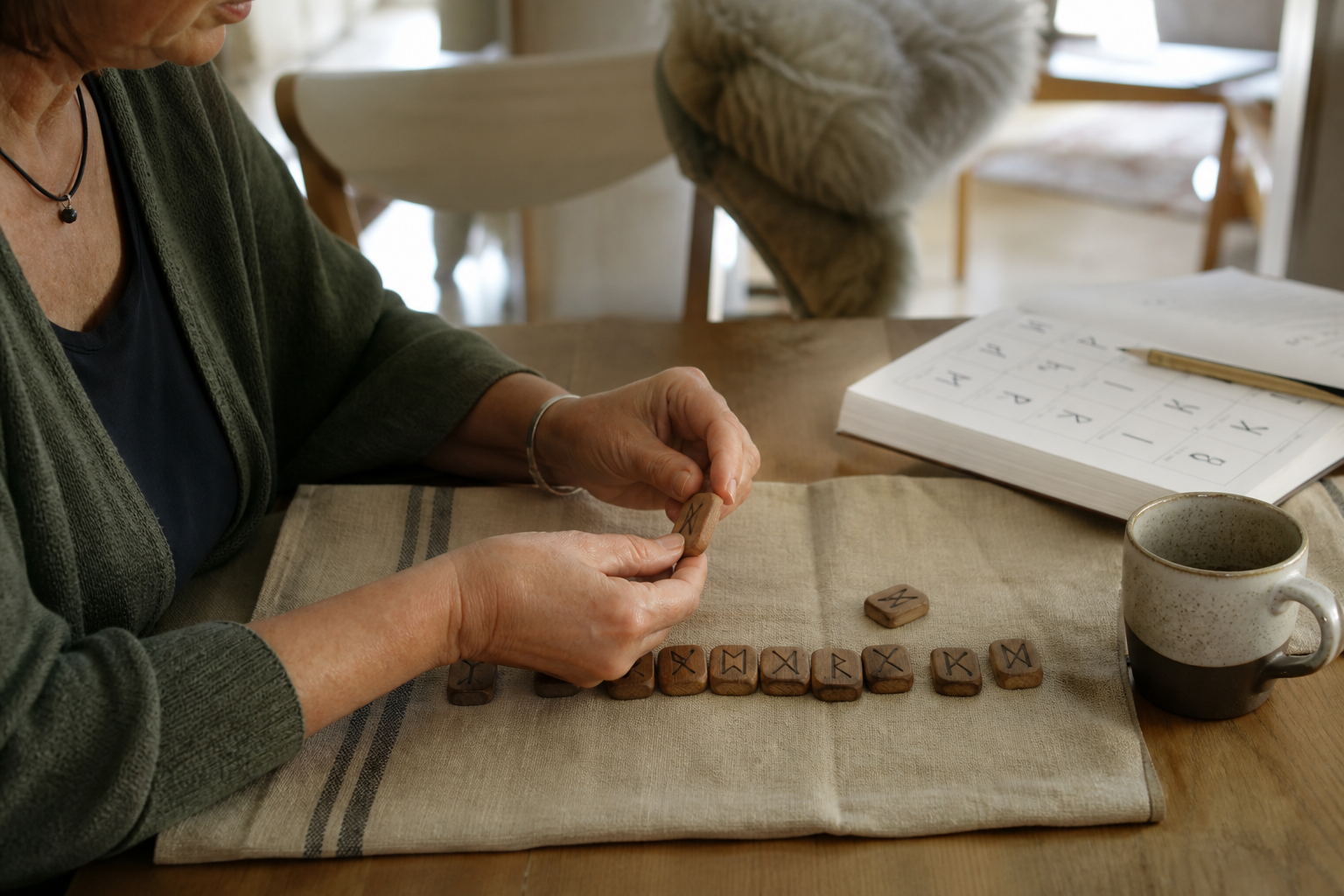
- Make a set, or don’t. Twenty-four labelled pieces of card are enough to try the exercise. Buying expensive stones is optional, not a requirement.
- Write one question. “What should I consider before accepting an invitation?” rather than “What will happen?”
- Draw one rune blind. Put it in front of you. Before looking anything up, write two lines on what the symbol’s name makes you think about your question.
- Read the meaning. Use the table. Note where it adds a thought and where it does not fit; both are useful.
- Choose one action. A safe, practical step you can check without relying on the draw. It is also fine to decide the reading adds nothing. Close the bag.
For a worked example, the three-rune reading uses three positions as prompts rather than guarantees.
Runes and “healing”
This site’s name comes from a modern tradition of using runes in wellbeing practice: choosing a symbol to focus on during a hard time, drawing one as a reflective prompt, holding a tile as a reminder of an intention. Some people find a personal ritual comforting, while others do not. Rune symbols are not medical treatment, and historical stories of charms document belief rather than cures. Our guide to using runes alongside medical care explains practical boundaries; keep treatment decisions with qualified clinicians.
Key takeaways
- Runes are historical writing systems. The earlier Elder Futhark has 24 characters; later alphabets differ.
- Modern divination rules vary. The blank tile is not a historical Elder Futhark letter.
- A reflective reading combines a question, a draw and your interpretation. It does not establish hidden knowledge.
- Use runes for reflection and ritual. Not for prediction, diagnosis, or anything anyone charges to “remove”.
- Paper and a pencil are enough to start.
Frequently asked questions
1. What are runes?
Runes are letters of historical alphabets used by Germanic-speaking peoples. The Elder Futhark has 24 characters; later alphabets have different sets.
2. What does “futhark” mean?
The name refers to the first six characters: F, U, Th, A, R and K.
3. Were runes used for fortune-telling in ancient times?
Historical sources describe writing and magical beliefs, but that does not establish that today’s casting rules reproduce an ancient method. Avoid presenting a modern spread as a documented ancient instruction.
4. What is the blank rune?
A blank tile is a modern addition found in some sets. It is not a letter of the historical Elder Futhark; using it is optional.
5. How do you read runes?
For reflection, write a low-stakes question, draw a rune, consider its interpretive themes and note what does not fit. Check any proposed step against practical facts.
6. Can runes predict the future?
Rune casting is not an established method of predicting events. Use an interpretation as a prompt, not evidence of what will happen.
7. Do I need to buy a rune set?
No. Labelled pieces of card are sufficient for a reflective exercise. Material, price and appearance do not establish predictive power.
8. What do the runes mean?
Historical letter names and modern divinatory associations are different things. The table offers commonly used translations and optional reflective questions; interpretations vary.
9. What is a reversed rune?
A rune may land upside down. Some modern readers use an alternative interpretation; others do not. Whether a character looks different depends on its shape and the chosen set.
10. Are runes connected to a religion?
Runic writing was used in different religious contexts. Some contemporary pagan practices include runes, while others use them without religious commitment. No single approach represents every tradition.
11. Can runes heal?
Rune casting is not medical treatment. An optional ritual may feel comforting, but it must not replace assessment or prescribed care.
12. What is the best rune for protection, love or money?
Algiz, Gebo and Fehu have protection, exchange and resource associations in some modern guidebooks. A symbol does not guarantee safety, love or income.
13. Is rune casting the same as tarot?
Both can be used as interpretive prompts, but their symbols, histories and reading conventions differ. An Elder Futhark set has 24 characters; a standard tarot deck has 78 cards.
14. What are bind runes?
Bind runes combine characters into one form. Do not assume a contemporary intention design has the same purpose or meaning as a historical inscription.
15. Why are runes angular?
Many rune forms use straight strokes. They were inscribed on different materials; shape alone does not prove one universal explanation for the script’s origin.
16. Where can I see real runic inscriptions?
Museums and heritage sites display runic objects and stones. The National Museum of Denmark’s pages are one place to begin; Jelling is a notable surviving monument.
17. What should I do if a reader says the runes show a curse?
A reading cannot establish a curse. Decline fear-based payments or escalating removal fees; you do not need to purchase a ritual to become safe.
18. How often should I read runes?
There is no required schedule. Avoid repeated draws seeking reassurance or a preferred answer. Pause if the practice increases anxiety or interferes with everyday decisions.
The fact that runes are believed to align with one’s spirit to provide answers is an intriguing concept. It adds a layer of personal connection to the divination process.
The explanation of individual runes and their meanings provides a helpful context for understanding how they might be interpreted in practice.
The historical context of runes is quite fascinating. It’s intriguing how they have transitioned from ancient times to modern spiritual practices.
The use of runes in ancient Nordic and Germanic tribes adds a rich cultural dimension to their modern usage.
Indeed, understanding their historical significance helps appreciate their role in contemporary spiritual practices.
Absolutely, it would be interesting to learn more about how these practices evolved over the centuries.
While the article provides a good overview of runes, it would be beneficial to have more scientific insights on how and why people believe in their power.
It’s interesting to see the similarities between runes and other divination tools like tarot cards. Both seem to provide guidance rather than definitive answers.