A love question can carry hope, tenderness, uncertainty and a wish to be understood. If runes are meaningful to you, they can give that reflection a shape: a symbol, a question and space to notice your response. You do not have to dismiss the spiritual meaning to keep another person’s feelings and choices outside the draw.
Quick answer
Runes can be optional prompts for thinking about your own choices in a relationship. A draw does not establish what another person feels, whether they are faithful or what they will do. Try a low-stakes question such as “What should I consider about how I communicate?” and stop rather than drawing repeatedly for reassurance. The method is in our rune-reading guide.
Why runes can prompt reflection, and where they fall short
A symbol may give you a starting point for writing, but interpretations are not unambiguous. Hope or fear can shape which meaning you choose. A reassuring rune is not permission to contact someone who asked for distance, and an unsettling one is not proof that a relationship is doomed.
Twenty-four relationship prompts
The keywords below mix related historical images and modern reflective associations; they are not one uniform set of ancient romance meanings. Names and translations differ between rune alphabets. Our rune alphabet and meanings guide provides the broader context. Treat every question here as an optional exercise, not a prediction.
1–8: Giving, strength and communication
1. Fehu (wealth)
What am I investing here, and is it being used well?
2. Uruz (aurochs)
Where is my strength in this, and am I using it or hiding it?
3. Thurisaz (giant / related thorn image)
Where am I defended? Is someone pushing, and is it me?
4. Ansuz (god / related communication theme)
What needs saying, and am I listening?
5. Raidho (journey)
Does this pace fit my wishes, limits and mutual consent?
6. Kenaz (torch association)
What have I not looked at? What is festering?
7. Gebo (gift)
Is the giving balanced?
8. Wunjo (joy)
Is there joy here, honestly?
9–16: Needs, uncertainty and boundaries
9. Hagalaz (hail)
What was outside my control, and what responsibility belongs to each person?
10. Nauthiz (need)
What do I actually need, as opposed to want?
11. Isa (ice)
What is frozen, and is waiting wise or avoidant?
12. Jera (harvest)
What has patient work produced, or not?
13. Eihwaz (yew)
What will endure here, and what am I enduring that I should not?
14. Perthro (uncertain name / chance theme)
What is unknown, and can I live with not knowing?
15. Algiz (modern protection theme)
What boundary do I need?
16. Sowilo (sun)
Where is the light, and am I letting it in?
17–24: Principles, feeling and shared life
17. Tiwaz (Tyr)
What principle matters, and what choice respects safety and consent?
18. Berkano (birch)
What is new and needs care?
19. Ehwaz (horse)
Are we actually moving together?
20. Mannaz (human)
Am I seeing them as a person or as a role?
21. Laguz (water)
What am I feeling that I have not said?
22. Ingwaz (Ing)
What is growing quietly, in me?
23. Dagaz (day)
What would help me understand the situation more clearly?
24. Othala (home)
What have I inherited about love, and do I want to keep it?
Gebo and a wish for more balanced time
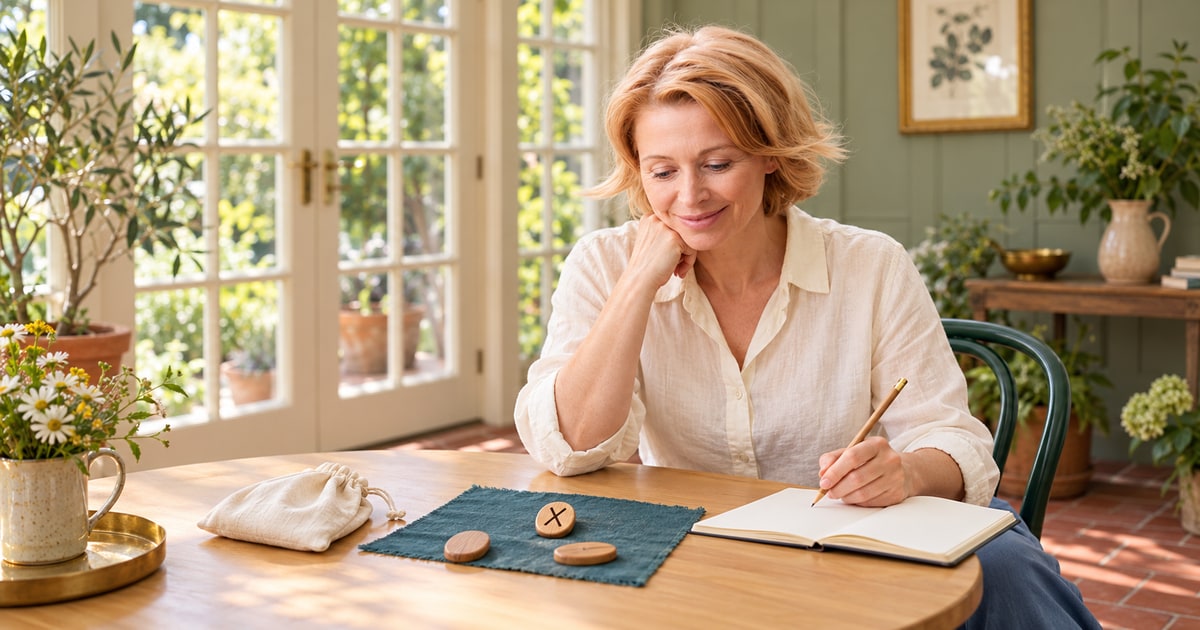
Imagine that you enjoy being with a partner but also want one quiet evening to yourself. You choose the Gebo question, “Is the giving balanced?” This hypothetical reflection concerns your own time and request; it does not reveal what your partner is thinking.
- 1. Put the symbol into your own words
- Write, “I value time together, and I also need rest.” That is your statement, not an instruction from a tile or proof that either person is giving too little.
- 2. Separate a fact from a guess
- “We have plans on several evenings” is something you can check. “They will be angry if I ask for an evening alone” may be an assumption—or a warning based on actual past behaviour. Do not use a rune to dismiss a genuine safety concern.
- 3. Make a request only if it is safe and welcome
- You might say, “I would like a quiet evening on Thursday. Would another evening work for spending time together?” Leave room for both people’s preferences, and respect a no.
- 4. Let the real response guide the next step
- Discuss practical options without treating a different preference as a failed reading. You may change your plans or decide not to act. If there is pressure, fear or coercion, leave the exercise and seek appropriate support rather than trying to find a better rune.
You can return the tile to its pouch and stop. Repeated draws are not needed to make the request valid, and a spiritual practice does not remove either person’s right to choose.
A smaller alternative to a ten-rune “heart” spread
Heart-shaped layouts differ between modern guides; this is not a reconstruction of a universal ancient ritual. If you want a longer exercise, these six prompts can organize your notes. You may use one or all of them, with paper notes instead of additional draws.
1. The situation as you see it
Describe what you have actually noticed; keep assumptions about motives separate.
2. How you see yourself
Name your part without taking responsibility for another person’s coercion.
3. What is working
Record specific examples rather than searching for a reassuring label.
4. A challenge
Choose a difficulty you can describe; a rune is not evidence that someone has done something.
5. What you want
Write a wish or boundary as yours, not as something the other person owes.
6. One action within your control
Choose a small practical step, or no action. It must respect safety, consent and any request for distance.
Your interpretation is not another person’s testimony.
Write fears plainly rather than assigning them predictive power. Ask a partner about their wishes only when communication is safe and welcome. Leave out forecasts and claims about hidden intentions. Taking responsibility for your own conduct never means taking responsibility for someone else’s coercion or abuse.
When not to use runes
1. Hidden facts or permission
To establish cheating, love, a reunion or consent. Respect a refusal, breakup or request for no contact; do not surveil someone.
2. Danger or coercion
To decide whether danger is real. Threats, coercion and violence deserve practical support, not a draw.
3. Distressing repetition
When repeated casting feels distressing or hard to stop. Put the runes away and consider a trusted person or professional support; a nightly ritual alone is not a diagnosis.
In the United States, the National Domestic Violence Hotline is available at 1-800-799-7233. Devices and internet use may be monitored; use a safer device if possible. Outside the US, contact a local domestic-abuse service. In immediate danger, contact local emergency services. Do not confront a partner or delay help because of a reading.
Key takeaways
- The 24 questions concern your perspective, not access to someone else’s mind.
- Modern spread rules and keyword associations vary.
- Consent, practical facts and safety take priority over a symbolic interpretation.
- You may stop a reading; no symbol requires pursuit, sacrifice or repeated payment.
Frequently asked questions
1. Can runes tell me whether someone loves me or is cheating?
A rune reading cannot establish those facts. Check concrete information and communicate directly only where safe and welcome. Do not use a draw to justify accusations, surveillance or unwanted contact.
2. What is a safer question for a love reading?
Ask about your own choices, such as what you need to communicate or which boundary matters. Compare any interpretation with facts. Your choices do not make you responsible for another person’s abuse.
3. Does a reversed or frightening rune mean the relationship will fail?
No. Interpretation and reversal rules vary, and a symbol is not a verdict or forecast. You can stop the reading instead of repeatedly drawing for reassurance. Decisions need practical information and appropriate support.
4. Should I consult runes when I feel unsafe with a partner?
No. Threats, coercion and violence are safety concerns, not spread questions. Seek support from a domestic-abuse service using a safer device if possible. Immediate danger requires local emergency services; do not wait for a reading.
The layout methods, such as the heart pattern for ten stones, present a structured way to interpret relationship dynamics. This shows a thoughtful approach to rune reading.
The historical context of rune stones adds a layer of depth to their use. The Elder Futhark set, with its 24 symbols, appears to be a complex tool for divination.
The straightforward nature of rune readings could be beneficial for those seeking direct answers. Yet, the harshness might deter some from using them in romantic contexts.
The use of runes for love guidance is quite intriguing. The bluntness may be a double-edged sword, offering clarity but potentially harsh truths.
While the insights provided by runes are fascinating, their efficacy and reliability in modern contexts remain debatable. More empirical evidence would be helpful.
It’s interesting to see the symbolic meanings of each rune and how they apply to matters of the heart. However, the potential for misinterpretation seems high.