Quick answer
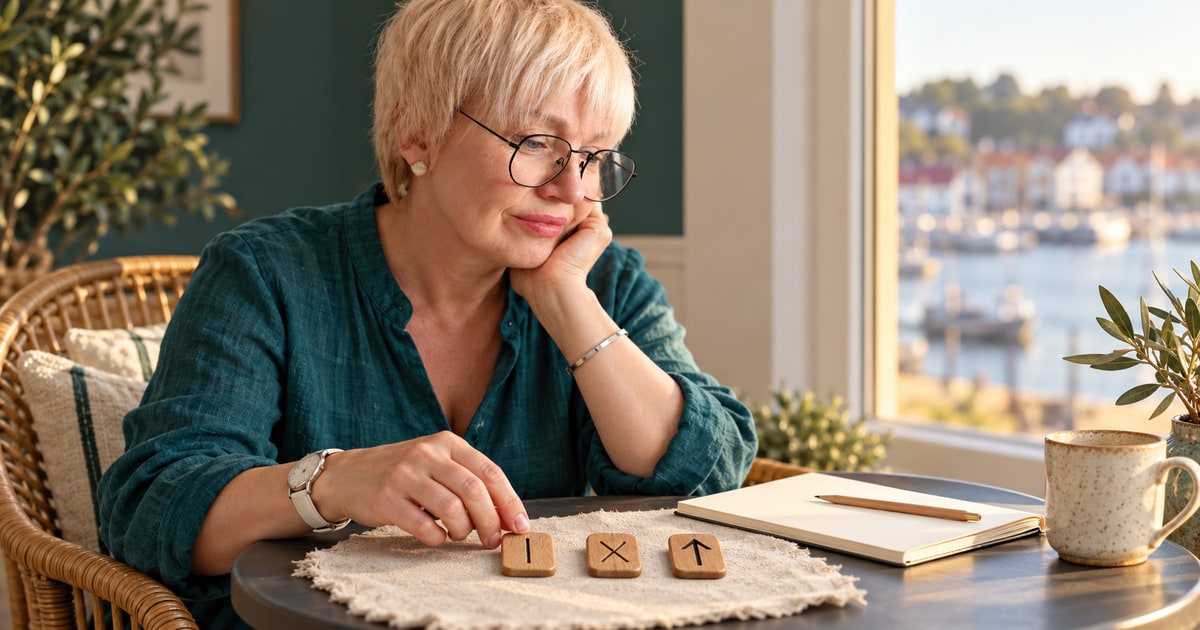
This is a deliberate-choice exercise rather than a blind draw: hold a question in mind, look at the list of runes below, and pick the one that stands out. You can use it to learn the names and explore personal associations. A choice is not a diagnosis, a prediction or evidence of a supernatural message. All 24 runes with full meanings and questions are in what are runes and how to use them.
A rune does not have to arrive with a dramatic feeling to be worth considering. If symbols are part of your spiritual practice, let this be a moment of curiosity rather than a demand to decode a hidden instruction. You can enjoy an association, disagree with a prompt or leave the exercise unfinished.
How the exercise works
- Write your question. Keep it about your own situation.
- Choose a name or symbol that catches your attention. If you have already read its prompt, simply note that influence.
- Write two lines about your association, then compare it with the modern prompt below.
- Consider a small, safe action supported by the facts of your situation, or finish without taking action.
A deliberate choice may reflect a familiar association, a visual preference or your mood; it cannot reliably reveal hidden thoughts. A blind draw introduces a symbol you did not select. If you want to compare the two approaches, the guide to reading runes explains a reflective draw. Neither approach establishes another person’s feelings or consent, predicts health or replaces practical advice.
The runes, in one line each
These are optional modern reflection prompts, not fixed ancient meanings. Rune names, translations and spiritual interpretations vary; labels such as chance or protection do not establish magical abilities or guaranteed safety.
Fehu
Optional reflectionResources; what you have to work with
Uruz
Optional reflectionStrength; where your energy goes
Thurisaz
Optional reflectionForce and defence; what you are pushing against
Ansuz
Optional reflectionSpeech; what needs saying or hearing
Raidho
Optional reflectionThe journey; the next step in order
Kenaz
Optional reflectionThe torch; what you now see clearly
Gebo
Optional reflectionGift; what you freely give or receive
Wunjo
Optional reflectionJoy; what is already good
Hagalaz
Optional reflectionHail; what hit you that you could not control
Nauthiz
Optional reflectionNeed; the need under the want
Isa
Optional reflectionIce; what is stuck
Jera
Optional reflectionHarvest; what your patience has produced
Eihwaz
Optional reflectionEndurance; what support you can return to
Perthro
Optional reflectionUncertainty; what you do not know
Algiz
Optional reflectionProtection; what needs a boundary
Sowilo
Optional reflectionClarity; where the light is
Tiwaz
Optional reflectionFairness; a safe, proportionate response
Berkano
Optional reflectionNew growth; what needs care
Ehwaz
Optional reflectionPartnership; who you move with
Mannaz
Optional reflectionThe human; what you share with others here
Laguz
Optional reflectionWater; what you feel and have not said
Ingwaz
Optional reflectionPotential; what is growing quietly
Dagaz
Optional reflectionDay; what you would like to clarify
Othala
Optional reflectionInheritance; what you keep from where you came from
A choice turned into a practical question
For example, you might choose Gebo because the idea of a gift catches your attention. Write your own association first: “I keep offering help even when I have no time.” The prompt can then become, “What can I freely offer this week, and what do I need to decline?”
One small action could be a clear, kind boundary. That is your considered response to your circumstances, not a command from the rune or a reading of someone else’s mind. If the example does not fit, do not force it to fit.
Keep the history and the exercise distinct
The National Museum of Denmark’s introduction to runes describes a historical Germanic writing system. This 24-name exercise draws on the Elder Futhark tradition, but its personal prompts are a contemporary activity, not a reconstruction of a single ancient ritual. You do not need a sacred pouch, a particular belief or an astrological correspondence to try it.
Frequently asked questions
1. Does the rune I choose predict my future?
No. A deliberately selected symbol can be a reflection prompt, but it does not establish future events, health outcomes or another person’s intentions.
2. How is choosing a rune different from drawing one?
Choosing lets a name or symbol guide your selection. A blind draw introduces chance into the selection. Both can be used as optional reflection exercises; neither proves a supernatural message.
3. Are these prompts the original ancient meanings?
No. They are modern prompts based on common contemporary associations. Historical rune names and translations vary, and runes were also used as a writing system.
4. What if no rune stands out or the prompt feels wrong?
You can stop, choose a different neutral prompt or ignore the exercise. There is no required message to uncover, and you do not need to repeat it until you get a reassuring answer.
Key takeaways
- All 24 prompts are optional starting points for reflection.
- Deliberate choice and blind drawing are different selection methods, not reliable prediction tools.
- Use real-world evidence, direct communication and appropriate professional help for consequential decisions.
The article’s mention of rune spreads and the comparison with tarot card readings provides a useful cross-reference for those familiar with tarot.
The breakdown of individual rune meanings is quite detailed. It provides a clear understanding of what each rune symbolizes.
Indeed, the associations with wealth, strength, and other attributes make it easier to apply the interpretations practically.
Yes, I found the explanations of symbols like ‘FEHU’ and ‘Uruz’ particularly insightful in understanding their broader implications.
The method of selecting a rune by focusing on a problem or question is interesting. It adds an intuitive element to the process.
The practical advice given at the end about using rune readings for personal guidance is a nice touch. It makes the ancient practice accessible to modern readers.
The historical context provided about the origins of runes is quite enlightening. It offers a solid foundation for understanding their significance.
I agree. The connection to ancient cultures like the Celtics and Scandinavians highlights the shared heritage of these alphabets.
It’s fascinating to learn that runes have astrological values and connections to natural cycles. This adds another layer of depth to their meanings.
I appreciate how this aspect ties into the broader spiritual and naturalistic traditions surrounding rune use.
Absolutely. The integration of astrological elements suggests that runes can provide holistic insights, blending both cosmic and earthly elements.