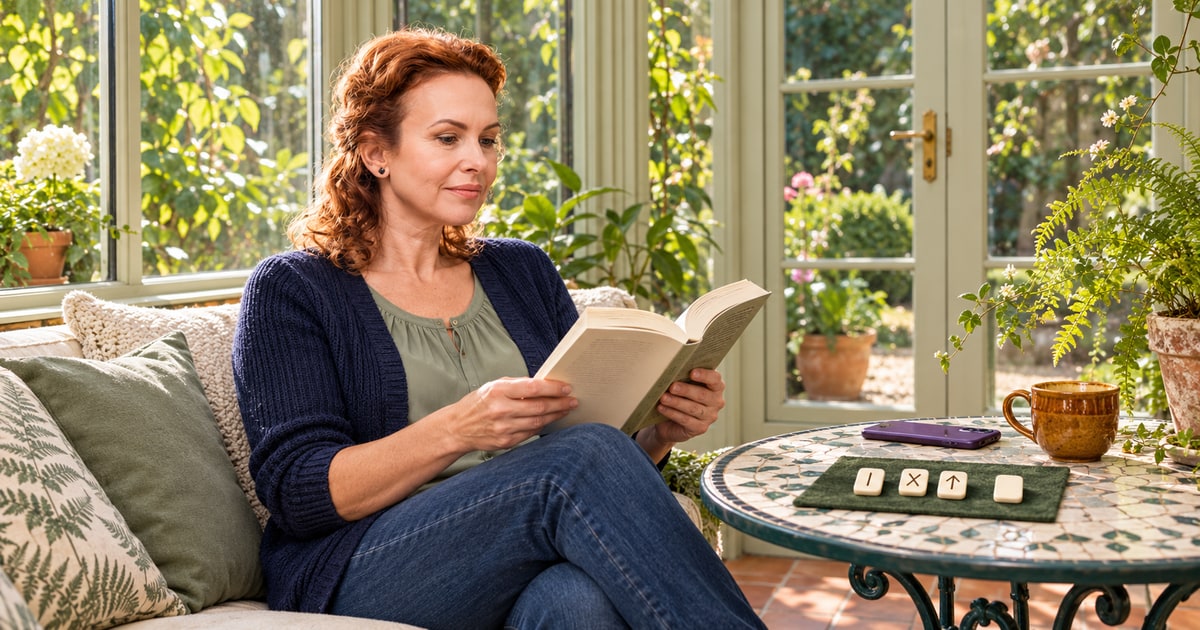
A rune book can be a companion to a meaningful spiritual practice: somewhere to meet a symbol, sit with a question and develop your own notes. Ralph Blum’s The Book of Runes is one well-known doorway into that experience. Knowing what belongs to his modern system lets you enjoy it without mistaking one author’s approach for the whole tradition.
Quick answer
Ralph Blum’s The Book of Runes is an influential modern oracle guide, not the source of all rune reading or a recovered Viking instruction manual. Its blank tile and interpretive order are features of a modern system. You may use symbols as optional prompts without accepting claims of prediction. For the historical alphabet, see what are runes and how to use them.
The older alphabet and the modern oracle
Blum developed a modern set of interpretations and an order for consulting the symbols, drawing partly on the I Ching. These are features of his approach, not archaeological proof of a recovered Viking oracle. The blank tile is not an extra letter in the 24-sign Elder Futhark.
Paul Mountfort’s study of runic guidebooks discusses Blum alongside other authors and earlier occult traditions. It cites the book in 1982; Macmillan’s current edition page describes an original publication in 1983. This bibliographic variation does not change the central distinction: the alphabet is ancient, while this book’s oracle system is modern. The anniversary edition’s publisher description explicitly calls its interpretations contemporary and lists a 25-piece set.
Why some beginners choose runes
A manageable starting set
A 24-sign Elder Futhark set can feel manageable, although names and forms vary between guides.
Optional orientations
Reversals are optional. You do not need an inverted meaning for every symbol, and an orientation is not good or bad news.
Your own learning pace
Choosing one symbol occasionally and writing a short note can be a study routine. It does not guarantee mastery in a month.
Accessible materials
Some people enjoy handling tiles; others prefer printed symbols or an accessible reference sheet. No expensive material is required.
What to keep, and what to leave
Keep
Questions that send you back to your own circumstances. A simple layout with clearly chosen positions. Space to disagree with an interpretation. If a three-symbol exercise appeals to you, try “what I know, what I am unsure about, and a next step I could consider” rather than treating the last position as a guaranteed outcome.
Leave
A yes-or-no draw as authority over a consequential choice. Repeated draws until you get a preferred result. Claims that tiles reveal past lives, another person’s private feelings or a fixed future. Do not confuse symbolic language with facts, consent or a professional assessment.
You can stop if the practice becomes upsetting or compulsive. For health, money and legal questions, seek appropriate qualified guidance; for relationships, communicate respectfully and accept the other person’s choices.
A three-position reflection you can adapt
This is a suggested personal exercise, not a reproduction of a particular spread from Blum’s book. Decide what each position means before you begin. Use drawn symbols, chosen symbols or simply the three headings.
What I know
Write down the circumstances you can already describe. Let a symbol remind you of a value or resource without turning it into extra evidence.
What I am unsure about
Name a genuine gap in your information. An association with a tile can suggest a question; it does not fill that gap.
A next step to consider
Choose a small option you can check in ordinary life. You can also decide to wait, ask someone or finish without taking action.
Starting a small herb garden
Imagine wanting a more satisfying weekend routine and considering a few balcony herbs. Rather than asking “Will this garden succeed?”, you might ask “What would help me begin at a pace I can enjoy?”
- 1. Name what you already have
- You have a spare planter and about an hour on Saturdays. Those are ordinary facts, whether or not you use a rune to reflect on them.
- 2. Leave uncertainty visible
- You have not checked how much sun reaches the balcony or which plants suit it. If a blank tile brings “not yet known” to mind, label that as your personal association—not a warning or a claim about the book’s prescribed meaning.
- 3. Choose a checkable next step
- Observe the light over several days and borrow a gardening reference before choosing plants. The reflection has helped organize your attention; the practical information still comes from looking and learning.
A short note could read: What I know / What I still need to learn / One thing I can check. You can value the spiritual moment and still leave the outcome open.
Choosing among different guides
Modern rune books and decks have different spiritual themes and interpretations. A healing-themed title does not establish medical effectiveness, and a spiritual theme does not make an interpretation universal. Check which alphabet and source a guide uses. You may keep a consistent set of notes for learning, compare methods openly or decide not to use a system that does not suit you.
For a simple exercise that treats a draw as a prompt rather than an answer, see learn how to read runes. It is fine to choose a symbol deliberately or write the question without tiles. Neither the book nor the object is required for thoughtful reflection.
A useful page in your notebook
Record the author or edition, the symbol, the book’s interpretation and your own response separately. “I disagree” and “I do not know yet” are useful entries. This makes it easier to compare guides without blending every meaning into a single supposedly universal message.
Key takeaways
- Blum’s influential system is one modern approach, not all rune practice.
- The blank tile is optional and is not a historical alphabet letter.
- Keep questions and choice; leave claims that a draw settles facts.
Frequently asked questions
1. Is Blum’s Book of Runes a recovered Viking instruction manual?
No. It is an influential modern oracle book using an older alphabet. Its interpretations and reading conventions should be distinguished from historical inscriptions and from other modern authors’ methods.
2. Is the blank tile part of the historical Elder Futhark?
No. The Elder Futhark has 24 written signs. A blank tile used as an oracle symbol is a modern addition; you can omit it without removing a letter from that alphabet.
3. Will a rune-a-day routine teach me everything in a month?
No timetable guarantees learning. An occasional symbol-and-note exercise can be a personal study routine, but pace, memory, interest and accessibility vary. You can pause or use a reference sheet.
4. Should I let a yes-or-no rune draw make an important decision?
No. A draw does not establish facts or consent. Use practical information, direct communication and appropriate professional advice for consequential choices rather than letting a tile decide.
I appreciate the historical context provided about Runes and their reintroduction by Ralph Blum. It’s fascinating how ancient tools can be adapted for modern use and still provide deep insights.
Ralph Blum’s personal journey with Runes and their meanings is quite compelling. It underscores the unique relationship one can develop with oracles over time, adding a personal touch to the practice.
The tactile aspect of using Rune stones and the connection to the Earth adds an interesting dimension to the practice. It highlights the sensory experience involved in readings, which can enhance the overall process.
The explanation of different Rune layouts and their applications is quite helpful. It seems that Runes offer both simplicity and depth, which can be beneficial for both beginners and experienced practitioners.
The idea of using Runes for yes/no questions and their ability to offer more detailed insights is intriguing. It sounds like a practical method for someone new to oracles.
The simplicity and profound impact of Runes make them a compelling choice for beginners. It’s interesting to read about how they can be used for quick readings and how they differ from more complex tools like Tarot.