You might be drawn to rune practice through a meaningful sound, a quiet moment or a simple creative act. There is no need to force all of those interests into one routine. These seven modern labels offer a way to compare possibilities, decide what fits your beliefs and leave out what does not suit your comfort, budget or health.
Quick answer
The seven styles listed here — breathing, magic, rune-shaped postures, meditation, cooking, chanting and radionics — are a modern esoteric grouping, not seven clinically validated treatments. Some may be meaningful as optional rituals, but “quantum” language does not demonstrate a healing effect. Our overview, can runes heal?, separates historical beliefs from evidence.
The seven styles and their practical boundaries
This is a comparison, not a seven-step programme or a list of required supplies. The everyday form and the boundary belong together.
Rune breathing
Everyday form: Slow breathing while looking at a symbol and repeating a phrase
Practical boundary: Some people find gentle breathing calming. Breathe comfortably without forced deep breaths or holds; stop if dizzy or distressed. The symbol is optional.
Rune magic
Everyday form: Ritual work from the modern “Northern path”
Practical boundary: Not an established treatment. Avoid fear-based rituals, unsafe materials or sellers promising cures; personal meaning does not make every practice harmless.
Rune yoga
Everyday form: Modern postures shaped like rune letters, developed in twentieth-century esoteric movements
Practical boundary: Keep movements within comfortable limits and seek advice when health or mobility makes them unsuitable. “Rune yoga” is a modern label, not proof of ancient continuity or a medical benefit.
Rune meditation
Everyday form: Sitting quietly with a rune in your lap
Practical boundary: Meditation may help some people, but benefits and risks vary; a rune-specific effect is not established. Stop or change the practice if it increases distress.
Rune cooking
Everyday form: Making a symbolic design on ordinary food with food-safe ingredients
Practical boundary: A creative activity, not a treatment or daily healing dose. Respect allergies and dietary needs; never add stone dust, unknown herbs or nonfood materials.
Rune mantras
Everyday form: Chanting rune names aloud
Practical boundary: Chant gently if comfortable; experiences vary and it need not be forced or prolonged. A meaningful sound is not a cure.
Rune radionics
Everyday form: Devices or software claimed to broadcast “frequencies”
Practical boundary: Do not rely on a claimed broadcast frequency for diagnosis or treatment. A device or software label is not clinical evidence; do not spend under pressure or postpone care.
A simple food design with personal meaning
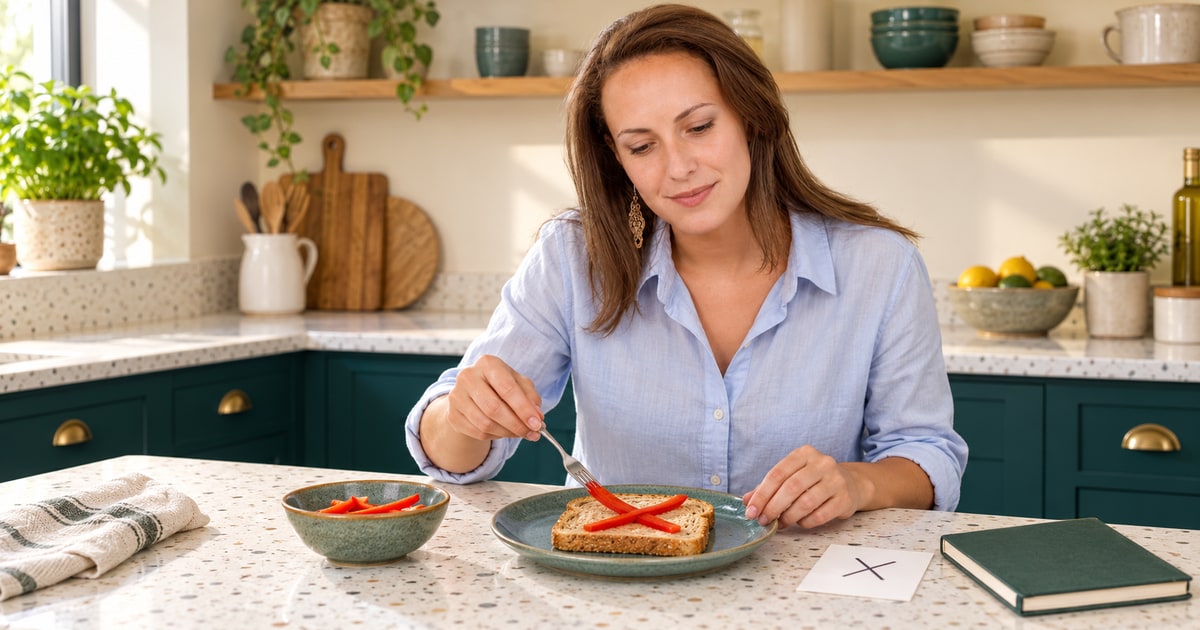
Imagine enjoying the creative “rune cooking” idea rather than wanting another meditation or posture. You might arrange two strips of an ordinary ingredient into an X on food you already planned to eat, and use the shape as a personal reminder of generosity.
- 1. Start with the ordinary meal
- Use food you normally eat and know is suitable for your dietary needs. Prepare it with your usual food hygiene. Keep paper, rune stones, craft materials and decorative dust away from the food; you do not need a special recipe.
- 2. Choose a meaning, not a dose
- You could think, “I would like to make room for one generous action today.” The arrangement does not change the meal into medicine, add a measurable healing frequency or create a daily requirement.
- 3. Keep sharing a choice
- If making food for someone else, respect allergies and preferences and ask whether they would enjoy the design. Do not add a spiritual promise to their meal. A drawing on a separate paper bookmark works as a no-food alternative.
One useful check is: Would I still want this meal or activity without a healing promise? If not, leave it out. Choosing no ritual is an equally valid option.
About “quantum” language, evidence and history
A technical label is not a mechanism
Phrases such as “Quantum Ocean” or “law of resonant frequencies” do not, by themselves, establish how a proposed rune treatment works or whether it helps patients. Ask for evidence for the specific device, practice and claimed outcome rather than accepting a technical-sounding label. A personal interpretation of a symbol is different from a demonstrated medical mechanism.
General practice research is not rune-specific proof
NCCIH’s meditation and mindfulness overview describes potential benefits, evidence limitations and possible unwanted effects. That is evidence about meditation practices studied, not proof that a particular rune has a healing frequency.
Modern labels need modern context
Historically, rune-shaped gymnastics belong to modern revivalist movements. Mountfort’s study discusses Marby’s and Kummer’s twentieth-century contributions and their esoteric context. The seven-item grouping is not a universal ancient classification.
For how to enjoy any of these alongside proper care, see Using runes alongside medical care: a safety guide.
Trying an optional ritual
Pick one comfortable, low-cost activity, such as a brief quiet pause with a symbol. You do not need a device, special food or paid activation. Let normal breathing and ordinary comfort guide the pace. If the exercise feels painful, dizzying or frightening, stop; not feeling a benefit is not a spiritual failure.
Do not change medication, delay tests or use a symbol to decide whether symptoms need help. NCCIH advises against replacing or delaying proven care with an unproven approach.
Key takeaways
- The seven styles are modern symbolic practices, not a medical menu.
- Comfort and safety vary; no practice is automatically harmless.
- Evidence must support the specific healing claim, not merely its vocabulary.
Frequently asked questions
1. Are these seven styles proven medical treatments?
No. This is a modern grouping of symbolic activities, not seven validated treatments. Evidence about ordinary meditation or movement does not establish a rune-specific cure.
2. Is rune yoga an ancient medical system?
Rune-shaped posture systems developed in modern esoteric movements. The label does not establish unchanged ancient origins, traditional yoga lineage or medical effectiveness.
3. How can I try a gentle rune ritual safely?
Keep it optional, comfortable and brief. Avoid forced breathing, painful postures and nonfood ingredients; stop if dizzy or distressed. Ask a qualified professional about activities unsuitable for your health or mobility.
4. Does quantum or frequency language prove that radionics works?
No. Technical-sounding terms and a device or software label do not establish diagnostic accuracy or clinical benefit. Ask for evidence for the specific claim and do not let it replace or postpone care.
The idea that runes can tap into universal healing energies is captivating. It’s worth considering how these practices align with or diverge from traditional medical approaches.
The integration of quantum physics principles with ancient rune practices is quite innovative. I’m curious to see if any interdisciplinary studies have been conducted to validate these methods.
The concept of using runes for healing is intriguing and connects well with quantum physics’ focus on energy. However, practical applications and empirical evidence are still areas needing more exploration.
While the theoretical foundation of rune healing is fascinating, I wonder if there are any documented case studies or anecdotal evidence supporting its efficacy.
The notion that runes, as symbols, can influence our auras and physical realities is a compelling blend of metaphysics and psychology. It invites further philosophical discussion.
It’s interesting how ancient practices are being recontextualized with modern scientific paradigms. This synthesis might offer new insights into how we understand healing and energy.