

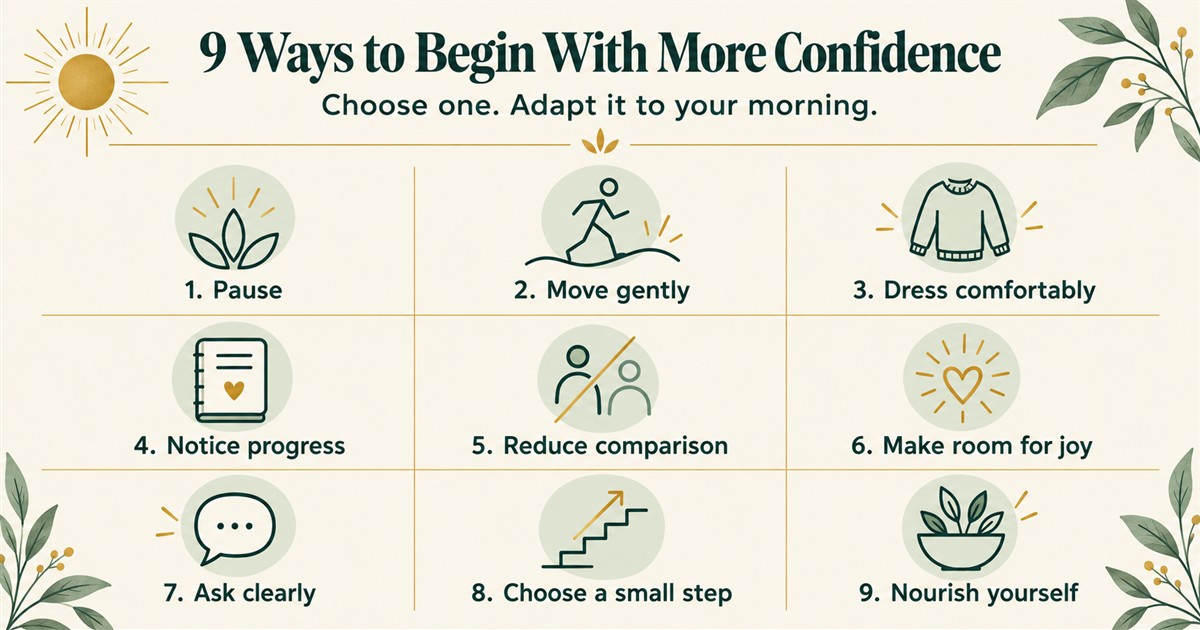
A more confident morning does not have to begin with a complete change of personality. You might simply want to feel a little less rushed, speak more clearly or make one choice that reflects what matters to you. If you use the phrase “raise my vibes,” let it describe that intention without making a difficult mood a spiritual failure.
The nine options below are a menu. Choose one that fits your health, time, resources and responsibilities. They are not a promise that a particular routine attracts good events, and you do not need to finish all nine before your day counts as a good effort.
1. Begin with a comfortable pause
Before opening the next task, notice where you are and what you need. You can sit, stand, keep your eyes open or listen to an ordinary sound. Meditation need not mean emptying the mind. If inward attention feels uncomfortable, orient to the room or choose another activity.
NCCIH describes several forms of meditation and their limits, including the possibility of unwanted experiences. A pause is optional, not something to push through when it makes you feel worse.
2. Choose movement that suits today
A brief walk, a comfortable stretch or moving to a favourite song may fit your morning. Adapt to mobility, health and surroundings; rest can be the appropriate choice. The point is to choose something manageable, not to prove determination by ignoring pain or exhaustion.
3. Dress for the person you are now
Pick clothes that suit the day and feel comfortable on your body. You do not need to earn an outfit through weight change or purchase a new wardrobe. Make one small adjustment that helps you move through the day more easily, whether that is useful shoes, a warm layer or something you enjoy wearing.
4. Recognize a small piece of progress
Name something you handled, learned or asked for recently. It might be making an appointment or getting through a demanding week. If gratitude helps, include something you appreciated alongside what remains hard. You do not have to describe every hardship as a gift.
5. Reduce unhelpful comparison
Notice when browsing other people’s achievements is taking attention from your own next step. You might delay a feed, mute an account or decide what information you actually came to find. Helpful feedback and real responsibilities still matter; confidence does not require dismissing every opinion.
6. Make room for a little enjoyment
Music, a view from the window or a hobby can be worth a place in your day without being a reward for productivity. Choose something affordable and realistic. If you cannot feel cheerful, you have not failed the exercise; making room for comfort is different from demanding joy on command.
7. Turn one concern into a clear request
Instead of carrying an entire frustration silently, identify a specific change that would help: “Could we decide who handles dinner before lunchtime?” or “I need ten quiet minutes before we start.” Venting and asking for support can also be legitimate. In a situation involving fear or retaliation, seek appropriate support rather than assuming direct confrontation is safe.
8. Choose a small step you freely want
You can try something new while feeling nervous, but an invitation is not an obligation. Check the cost, time, safety and preparation involved. A manageable first step may be asking a question, practising privately or declining an opportunity that does not suit you. Fear is information to examine, not always a command to push ahead.
9. Make nourishment easier
Think about what food or drink is available and appropriate for your needs. Preparing something simple or asking for practical help may serve you better than following an influencer’s ideal routine. Avoid dividing food or people into spiritually high or low categories. Follow relevant personal clinical advice rather than treating a gut feeling as a substitute.
Free one-choice morning planner
Complete this in your head or a private note:
- Today’s reality: What time, energy and support do I actually have?
- One choice: Which of the nine options would be useful?
- The smallest version: What can I do without making the morning harder?
- My request or boundary: What help or adjustment would make that possible?
- A fair review: What did I notice, without grading my worth by my mood?
Example: “I have a busy morning and feel rushed. I will choose comfortable clothes now and send one clear message about the evening plan.” You can change the plan when circumstances change.
Where spiritual meaning can fit
You might pair a choice with prayer, an intention or a meaningful object. Let it remind you of a value, such as patience or courage, without making it responsible for whether the day goes well. Our higher-self reflection questions offer another way to explore values.
If you enjoy runes, the optional rune-reflection exercise connects a symbol with a practical question. You can choose an action because it makes sense for your day rather than because a draw told you it must happen.
Confidence can include uncertainty, asking for help and starting again. A useful routine makes room for your actual life; it does not require you to be positive before you deserve care.
Frequently asked questions
1. What does raising my vibes mean in this guide?
It can mean wanting to feel more connected, prepared or confident. It is personal or spiritual language, not a measured frequency or a guarantee about events.
2. Do I need to do all nine options?
No. Choose one that fits your circumstances. The list is a menu rather than a daily test.
3. Must I wake up earlier?
No. Adapt a small choice to your schedule rather than sacrificing needed sleep to copy someone else’s morning.
4. Does meditation require a blank mind?
No. People use several forms of attention and reflection. A comfortable pause with your eyes open or attention on the room is also an option.
5. What if a meditation makes me feel worse?
Stop or change activities and seek appropriate support if distress persists. You do not need to push through to prove commitment.
6. Does movement have to be exercise?
No. Choose a comfortable activity suited to your health and mobility. Rest may be the right choice when needed.
7. Do I need new clothes to feel confident?
No. Choose what you already have that fits the day and feels comfortable. Your worth does not depend on an outfit or body change.
8. Can gratitude coexist with disappointment?
Yes. You can appreciate one thing while acknowledging pain, frustration or unmet needs. Gratitude does not require denying difficulty.
9. Should I ignore everyone’s opinion?
No. Distinguish useful feedback and real responsibilities from comparison that is distracting you from your own priorities.
10. Do I have to feel happy every morning?
No. Enjoyment and comfort can be welcome without becoming requirements. A difficult mood does not make the day or you a failure.
11. How do I turn frustration into a request?
Name a specific change, person and time where possible. If direct communication could trigger retaliation, seek support rather than assuming confrontation is safe.
12. Should I say yes whenever I feel nervous?
No. Check what you want, the actual risks and the preparation involved. You can choose a smaller step or decline.
13. Is there a high-vibration diet?
This guide does not prescribe one. Attend to nourishment suited to your needs, resources and relevant clinical advice rather than spiritual food rankings.
14. Can prayer or runes be part of my routine?
Yes, if meaningful to you. Use them as reminders or reflection prompts while keeping practical judgment and freedom to choose.
15. What is a realistic sign of progress?
A clearer request, a manageable choice or asking for help can matter. You do not need an immediate mood change or a perfect routine.